
GENERAL INFO
TRAVEL IDEAS
- Authentic Vic Falls and Botswana Safari, 11 days
- Botswana & Zimbabwe Adventure, 13 days
- Chobe Elephants and Victoria Falls, 5 days
- East Africa Explorer (Adventure), 21 days
- Intimate Zimbabwe, 15 days
- Okavango & Wildlife Adventure, 10 days
- Victoria Falls, Chobe & Okavango Delta, 7 days
- Victoria Falls and Hwange, 5 days
- Victoria Falls, 3 days
- Group Travel
RECOMMENDED EXTENSIONS
ESCORTED TOURING
- Great Zimbabwe Experience, 11 days
- Mana Canoe Trail, 4 days
- Victoria Falls Activities
STAYS OF DISTINCTION
- Victoria Falls Hotel, 3 days
- Little Makololo, 3 days

Zimbabwe
THINGS TO KNOW BEFORE YOU GO.
INDIGENOUS LANGUAGES:
Shona and Sindebele however, English is the official language.
USEFUL PHRASES:
English - Shona Ndebele
Hello (initial) - Mhoro/Mhoroi Sawubona/Salibonani
Hello (in reply) - Ahoi Yebo
How are you? - Makadii/Makadi-ni? Linjani/Kunjani?
I'm well - Ndiripo Sikona
Thank you - Ndatenda/Masvita Siyabonga kakula
Welcome - Titambire Siyalemukela
Good morning - Mangwanani Livukenjani
Good afternoon - Masikati Litshonile
Good evening - Manheru Litshone njani
Goodbye (to person staying) - Chisarai zvakanaka Lisalekuhle
Goodbye (to person leaving) - Fambai zvakanaka Uhambe kuhle
Please - Ndapota Uxolo
Excuse me - Pamsoro.ipindeo Ngicela ukwedlula
Sorry/pardon - Pamsoro Ngiyaxolisa
Do you speak English? - Unodziva kutawura chirungu? Uyakwazi ukukuluma isilingu?
Yes - Ehe Yebo
No - Aiw Hayi
Where is…? - Arikiupi…? Ungaphi…?
SEASONS & CLIMATE:
SUMMER: October - April, days are hot and generally sunny in the morning with possible afternoon thunderstorms. Daytime temperatures can rise to 30°C and night temperatures drop to around 14°C - 16°C. The temperatures given are those for the main centres but it is considerably warmer all year round in the low-lying areas such as Kariba, Victoria Falls, and the Zambezi Valley. The rainy season runs from November to March, although the Eastern Highlands are damp for most of the year.
WINTER: May - September, days are dry, sunny and cool to warm while evening temperatures drop sharply. Daytime temperatures generally reach 20°C and can drop to as low as 5°C at night. Please note that exceptionally cold spells can occur (although this is the exception rather than the rule) so it is recommended to bring appropriate clothing, just in case!
WHAT TO PACK:
Generally, casual comfortable clothing is suitable throughout the year. The most practical items to pack for safari are:
- blouses with long sleeves (even in summer, they will protect you from the sun and from mosquitoes)
- T-shirts
- shorts or a light skirt
- jeans or trousers for evenings and cooler days
- fleece or sweater and a warm jacket for game drives (necessary, even in summer)
- comfortable walking shoes
- sun block, sunglasses, hat, insect repellent - essentials!
- binoculars and a camera are a must
- track suit - good for sleeping in during winter months
- light, compact raincoat is a good idea for the summer
- swimsuit, as most hotels/lodges have swimming pools
- towel, flashlight and sleeping bag for camping safaris (sleeping bags can be hired from most safari operators)
Elegant casual outfit for dinner and/or cocktails at the smarter hotels and restaurants - men are generally expected to don collar, jacket (sometimes even a tie) in cocktail bars and restaurants after 18:30, except in the warmer parts of the country and at the game lodges.
Layers are most practical for the fluctuating day/night temperatures of Zimbabwe. Dull and/or neutral colours are more suitable for safari, white is not practical. It is best to pack hardy, durable clothing.
If you are travelling with an organised safari, it is important to check what your weight limit is. Generally you will need to restrict your luggage to 10-12 kg (packed in a soft bag) plus a reasonable amount of camera equipment.
WHEN TO GO:
Zimbabwe is an all year round destination. However there are certain seasons for special interest groups to take note of:
- For high adventure enthusiasts, white water rafting is most exciting when the Zambezi waters are low, generally from August to December.
- Best botanical months to visit the famous Vumba Botanical Gardens are December - May when the vegetation is lush and green, and also when most plants are in flower.
Zimbabwe's popularity as a destination is gaining in leaps and bounds to the extent that seasonal differences are not as marked as in previous years. Traditionally, however, peak season is from July - October and middle season is from May - June. Note that availability is at a premium during these seasons so you will need to book in advance. These are the most comfortable times for travelling, but it is during the wet summer, from November - April, when the landscapes are a striking, fresh green. However, the abundance of water means that it is less certain that wildlife can be seen at perennial water holes.
CULTURE:
The Shona people make up about 71% pf the population and are the ruling class of Zimbabwe. The Ndebele make up about 16% and occupy the area around Bulawayo and Victoria Falls. There is slight animosity between these two tribes.
VISAS:
Visas are required for all US and Canadian passport holders. Please check with your nearest Zimbabwean Consulate for the most up to date information on visas and pricing. Visas can also be obtained on arrival (paid in cash US Dollars) or in advance. Please check with the Zimbabwean Consulate for details and regulations. All rates are subject to change without notice. Please note if you leave Zimbabwe to enter another country, and then come back into Zimbabwe, you will either need a multiple entry visa or you will need to purchase another single entry visa locally. Passport valid for at least six months beyond date of departure is required with two blank pages.
GENERAL ACCOMMODATION INFO:
It is strongly recommended that you reserve all your accommodation as far in advance as possible if you plan to visit Zimbabwe during the peak season since availability is at a premium during this period. There are many private game reserves with standard and luxury accommodation. The national parks include cottages, chalets or lodges, which are all fully equipped. Booking is always essential. Note that foreigners are required to pay in foreign exchange; US$ are preferred. The government campsites are well-maintained and offer full facilities.
GETTING AROUND:
Airports
Domestic air services operate between the major airports:
- Harare Airport (HRE)
- Bulawayo Airport (BUQ)
- Karibe Airport (KAB)
- Victoria Falls Airport (VFA)
There are a total of 467 runways in Zimbabwe, of which only 18 are paved. Charter air services can be arranged to reach remote areas. These tend to be very expensive, but are cheaper when booked through a tour operator.
Roads
There are 18, 338 km of highways in Zimbabwe, of which 8, 692 km are paved. Excluding the national parks and game reserves, the road conditions in Zimbabwe are good and they are well- signposted. Four-wheel drive vehicles are advisable for travelling within the national parks and game reserves.
Foreign drivers may use their valid driving license, with an English translation if necessary. Driving is on the left side of the road and the general speed limit is 120 km/h on open roads and 60 km/h in urban areas, but watch out for the signs. Motorists must use their headlights between 5:30 pm and 5:30 am. Watch out for wildlife on the roads!
HEALTH:
It is imperative that you obtain malaria prophylactics before entering Zimbabwe. When purchasing these, please tell your doctor or pharmacist which areas in Zimbabwe you intend visiting. Start your course at least 24 hours before entering Zimbabwe and continue taking the pills for 6 weeks after leaving the country. If you suffer from side effects, try taking your malaria prophylactics at night, after dinner as this usually minimises the effect of the symptoms. Precautionary measures that you can take to prevent contact with mosquitoes are: sleeping under a bed net or in a room/tent with mosquito proofing (remember to keep the flaps zipped at all times); spraying your accommodation with insecticide; making use of a mosquito-repelling lotion or stick; and wearing long-sleeved clothing, long trousers and socks when outside at night.
Any person entering Zimbabwe from, or via, a yellow fever or cholera infected area must be in possession of a valid International Certificate of Vaccination against Yellow Fever and/or cholera.
Avoid swimming in dams and rivers as the water may be infected with bilharzia. If you are canoeing or rafting and cannot avoid the water, this is not a problem - just remember to towel off as soon as possible. Tap water is perfectly safe to drink and only in extremely remote areas is it necessary to boil or purify the water. Tetanus immunisation is recommended.
MEDICAL SERVICES:
Zimbabwe does not have a national health welfare scheme. It is therefore advisable to obtain medical insurance prior to arrival. It is also wise to bring with you, any medicines which you may require since you will not have access to pharmacies in many of the areas which you may be visiting. Medical services within Harare and Bulawayo are very good, but outside of this facilities are scarce. Bring any medicines you may require with you. Note that in some parts doctors often expect cash payment.
WATER:
Throughout Zimbabwe at hotels, inns, lodges and other public places, tap water is purified and perfectly safe to drink.
CREDIT CARDS / TIPPING:
Clients must carry cash in $US Dollars when travelling to Zimbabwe. Please make sure you have a sufficient amount of foreign currency in your possession, prior to entering the country.
It is best to travel with small denominations of foreign currency. By law, when guests are settling all extras at hotels in Zimbabwe, they are required to pay in foreign currency. However, no change will be given in foreign currency, but only in Zimbabwe Dollars, which cannot be taken out of the country on departure.
When paying in USD, all airports, immigration offices and many other vendors/shops will only accept US Dollar notes with the 'large heads' printed on them. These are the US Dollar notes printed after 2001.
Tips of 10% are usually expected by taxi drivers and at hotels. Service charge is often included in a bill, but when not, a 10% tip is acceptable.
Lunar Rainbow Tours
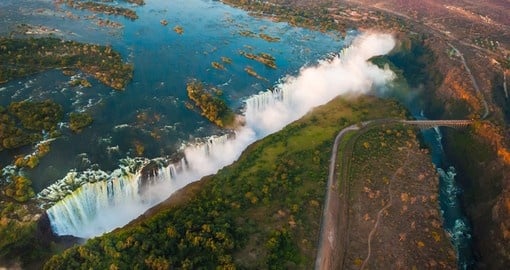
Lunar rainbows, also known as "moonbows", are rainbows that take place at night, when a rainbow is seen in the light of the moon. Victoria Falls is one of a very limited number of sites around the world, which are known for the occurrence of moonbows. The lunar rainbow is a spectacular event that can be seen only during the full moon. The Lunar rainbow tour is conducted over a period of 3 days, during full moon at the Victoria Falls.
Clients will be accompanied through the Rainforest by one of our qualified Guides who will give a brief history of the Falls themselves as well as other points of interest. Guides are also happy to assist clients with photographs whilst visiting this most spectacular of waterfalls. Raincoats are provided when needed. Lunar Rainbow Tours are available on the Zimbabwean and Zambian side of the falls.
NOTE: Please bear in mind that during low water season (around October through December), the Falls become just little rivulets running over the edge. In some places along the 1.7km width there is no water falls at all. The lunar rainbow will not be visible from the Zambian side of the falls during this period. This tour operates on both the Zimbabwe and Zambia side of the falls, but during October - December the tours only operate on the Zimbabwe side.