
BUCKET LIST
HONDURAS ITINERARIES
- Honduras in Depth, 9 days
- World of the Maya, 10 days
LATIN AMERICAN DESTINATIONS
- Antarctica (12 trips)
- Argentina (28 trips)
- Belize (6 trips)
- Bolivia (10 trips)
- Brazil (28 trips)
- Chile (30 trips)
- Colombia (9 trips)
- Costa Rica (7 trips)
- Ecuador (14 trips)
- El Salvador (4 trips)
- Falkland Islands (2 trips)
- Galapagos (14 trips)
- Guatemala (7 trips)
- Honduras (2 trips)
- Panama (6 trips)
- Peru (36 trips)
- Uruguay (3 trips)
- Venezuela (2 trips)

HOLIDAYS OF A LIFETIME
- Splendours of South America (2012), 17 days
- Splendours of South America (2013), 15 days
- Magical Ecuador and Peru (2012), 20 days
- Magical Ecuador and Peru plus Bolivia (2013/2014), 23 days
- Best of Ecuador, 11 days
- Cradle of the Incas, 13 days
Trekking, walking, wildlife encounters, cycling, rafting, sailing, cruising, camping, safaris, overland journeys and more.
Latin America Brochure
World of Adventure Brochure
Honduras
Country General Information
The Long Count Calendar of the Ancient Mayans ends on Dec 21 2012.
What does that mean? Your guess is a good as anybodies as the variations in hypothesis is as varied as the region in which the Mayan inhabited at the peak of their civilization.
Occupying the Yucatan peninsula and what is modern day Mexico, El Salvador, Honduras and Guatemala the civilization came into being 2000 BC reaching its zenith between 250 and 900 AD the Mayans the fist pre Colombian society to have a fully developed written language as well as complete and complicated mathematical and astronomical systems. This astronomical system or calendar (Long Count Calendar) and the end of one cycle is what all the fuss is about as we approach 2012.
Though the Mayans have calculated that the date of December 21st, 2012 A.D. (13.0.0.0.0 in the Long Count) marks the end of a cycle and a beginning of a new one - they did not stipulate or predict what this ending and new beginning may denote.
There are generally two schools of thought. One is a more holistic spiritual view where we see simply see the ending of one phase and the beginning of a new.
The other is the more "Hollywood view" where a catastrophic event may take place with some evening predicting the end of the world as we know it.
Despite what view you may ascribe to, in 2012 there is an amazing coinciding of mother natures "pieces" falling in to place and alignment.
"The date December 21st, 2012 A.D. (13.0.0.0.0 in the Long Count Winter Solstice Sun with the crossing point of the Galactic Equator (Equator of the Milky Way) and the Ecliptic (path of the Sun), what that ancient Maya recognized as the Sacred Tree."
Many of the famous Mayan sites in and around the Yucatan peninsula display images of the Milky Way and the Sacred Tree motif it being a vital part of the Mayans belief.
This crossing of the Galactic equator and the path of sun represents to the Mayans a sacred doorway where a human being enters into life, and enters or exits into death as well.
The web is a buzz with all different theories as to what will happen in 2012 as well as detailed recounting of the histories and structures of the astronomical calendars and the history and records of the Mayan.
So if you believe great physical change will take place in 2012 travel now and be at the "source" of a global change. More a believer in the spiritual transformation then plan your journey for 2012 or even plan to be there Dec 21st 2012.
No matter what happens Goway will be there with our fantastic itinerary taking in the best of modern day and ancient Mayan culture - 10 day World of the Maya - visiting El Salvador, Honduras and Guatemala with great opportunities to extend your journey in to Belize or south to Costa Rica and or Panama.
With departures every Wednesday or Saturday you will visit local workshops witnessing handicraft techniques dating back to Mayan times as well Copan ruins in Honduras and Tikal as well as the famous markets of Chichicastenango and Antigua de Guatemala in Guatemala.
Want to be in the heart of the Mayan World - Tikal - on December 21st then join our dedicated World of the Maya departure 15th December 2012.*
Also on offer are itineraries such as the Best of Guatemala 8 days, Tikal & Belizean Adventure, 9 days or Honduras in Depth 9 days.
Change is good, change is healthy but travel is priceless. Join us and venture into one of the great mysteries as it plays itself out in our life time in the "World of the Maya".
*Conditions apply
- Country Facts
- Climate
- Money
- Food & Drinks
- Travel Info
- Passport & Visas
Central America.
Area
112,492 km² (43,433 sq miles).
Population
8,143,564 (July 2011 est.)
Population density
64.9 per km².
Capital
Tegucigalpa. Population: 1.2 million (2005).
Government
Republic.
Geography
Honduras shares borders in the southeast with Nicaragua, in the west with Guatemala, and in the southwest with El Salvador. To the north lies the Caribbean and to the south the Pacific Ocean. The interior of the country comprises a central mountain system running from east to west, cut by rivers flowing into both the Caribbean and Pacific. The lowlands in the south form a plain along the Pacific coast. The Gulf of Fonseca in the southwest contains many islands which have volcanic peaks.
The large fertile valleys of the northern Caribbean lowlands are cultivated with banana plantations. However, large areas of land in Honduras are unsuitable for cultivation. The majority of the population lives in the western half of the country, while the second-largest concentration of people is in the Cortés area which extends northwards from Lake Yojoa towards the Caribbean.
Language
The official language is Spanish. English is widely spoken by the West Indian settlers in the north and on the Bay Islands off the Caribbean coast. Amerindian dialects are also spoken.
Religion
Roman Catholic majority, Protestant minority.
Time
GMT - 6.
Social Conventions
There are strong Spanish influences, but the majority of the population is mestizo, mainly leading an agricultural way of life with a low standard of living. Many rural communities can still be found living a relatively unchanged, traditional lifestyle. Social courtesies should be observed. It is customary for a guest at dinner or someone's home to send flowers to the hostess, either before or afterwards. Conservative casual wear is widely acceptable with dress tending to be less conservative in coastal areas. Beachwear and shorts should not be worn away from the beach or poolside. Men are required to wear dinner jackets for formal social occasions. Hotels, restaurants and shops include a 12% sales tax on all purchases.
Electricity
110/220 volts AC, 60Hz.
Head of State
President
History
(With thanks to Lonely Planet)
Pre-columbian history
The oldest known evidence of human presence in present-day Honduras are stone knives, scrapers and other tools thought to be 6000 to 8000 years old, and uncovered by archaeologists in 1962 near La Esperanza, Intibucá. Central America’s earliest occupants almost certainly were Paleo-Indians from the north, but linguistic and other evidence suggests that many indigenous people present in Honduras today (Pech, Tawahka and probably Lenca) are descended from later migrations of people from rainforest regions of South America, especially present-day Colombia.
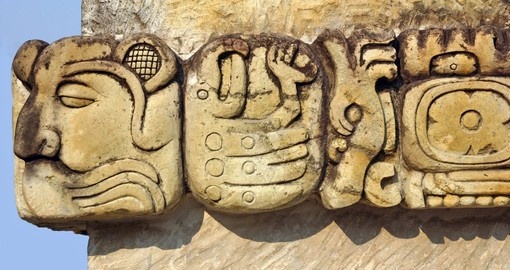
The Maya arrived in Honduras by way of Guatemala and Mexico, and settled in the fertile Sula, Copán and Comayagua valleys. Over centuries, they came to dominate the area, as they did much of Mesoamerica. Copán was a heavily settled, agriculturally rich trading zone and eventually became one of the great Maya city-states of the Classic Period (AD 300–900). The Classic Period ends with the rapid and mysterious collapse of most Maya centers, including Copán, where the last dated hieroglyph is from AD 800.
The Maya population declined precipitously, but did not disappear, of course. They were just one of many indigenous groups that made up Honduras’ native population when European explorers began their conquest of the American mainland. Copán has since returned to prominence as an archaeological mother lode, having more hieroglyphic inscriptions and stone monuments than any other Maya ruin. Copán was the first site visited by John Lloyd Stephens and Frederick Catherwood on their groundbreaking exploration of Mesoamerica in 1839. It was also the first site to be studied by Alfred Mausley (in 1885), whose compendium of Maya stone monuments remains a classic in the field, and whose work prompted the preeminent Harvard Peabody Museum to enter into Maya investigation (and which in turn selected Copán as its inaugural excavation). And it was the first stop for Sylvanus Morley and the Carnegie Institute in the 1920s. More recently, research has focused on Copán’s outlying areas; the site has provided important insight into the lives of ordinary Classic-era Mayas.
Conquest & colonization
On his fourth and final voyage, Admiral Christopher Columbus made landfall near present-day Trujillo. The date was August 14, 1502, and was the first time European explorers set foot on the American mainland. Columbus named the area Honduras, or ‘depths, ’ for the deep waters there. Before the historic landing, Columbus also had had his (and Europe’s) first encounter with mainland indigenous people: a crew of a large canoe he spotted near the Bay Islands. Columbus commandeered the canoe, which was laden with trade goods, and forced its captain (probably a Mayan merchant) to serve as his guide. The expedition continued east around Cabo Gracias a Díos (another of Columbus’ placenames) all the way to present-day Panama, where the admiral dropped his unlucky captive before returning to Spain.
Having been the site of such a historic landing, the Honduran Caribbean coast was all but ignored by explorers for the next twenty years, who focused instead on Mexico, Panama and the Caribbean islands. Hernán Cortés’ expedition into the Aztec heartland, however, revived interest in Central America. Exploration of the region was marked by feuding among would-be conquistadores: Gil González Davila ‘discovered’ the Golfo de Fonseca and tried claiming it as his own, only to be captured by rival Spaniard Cristóbal de Olid, who had similar designs. González Davila turned the tables, however, by luring Olid’s men to his side, then capturing and beheading Olid. Hernán Cortéz and others tried to quell the feuding, but to no avail.
The discovery of gold and silver in the 1530s drew even more Spanish settlers and, more importantly, increased the demand for indigenous slave labor. Native Hondurans had long resisted Spanish invasion and enslavement, and in 1537, a young Lenca chief named Lempira led an indigenous uprising against the Spanish. Inspired by Lempira’s example, revolt swept the western region, and the Spanish were very nearly expelled. But Lempira was assassinated at peace talks arranged with the Spanish in 1538, and the native resistance was soon quelled. A cycle of smaller revolts and brutal repression followed, decimating the native population. African slaves were introduced in the 1540s to fill the growing labor shortage.
Mining sustained the colony for the remainder of the century, but a collapse of silver prices (and the constant challenges of excavating such rugged terrain) devastated the Honduran economy. Cattle and tobacco enterprises gained some traction, and a change in the Spanish throne in the early 1700s reduced corruption and helped revive the mining industry. However, another upheaval in Spanish rule in 1808 – when Napoleon installed one of his own on the Spanish throne – sparked revolts on both sides of the Atlantic, which irreparably damaged Spanish colonial rule.
Birth of a nation
On September 15, 1821, Honduras, Guatemala, El Salvador, Costa Rica and Nicaragua declared independence from Spain, and shortly thereafter joined the newly formed Mexican Empire. The relationship didn’t last long, and in 1823, the same countries declared independence from Mexico and formed the Federal Republic of Central America. Though Honduras was the poorest and least-populated of the countries, it produced some of the federation’s most important leaders. Chief among them was the liberal hero General Francisco Morazán, commonly dubbed the ‘George Washington of Central America’, who led the federation from 1830 to 1838. But bitter conflicts between liberals and conservatives proved too divisive for the nascent union, and in May 1838 the Central American Congress freed its members to form independent states – Honduras did so on November 15th of that year.
The liberal and conservative factions continued to wrestle for power in Honduras after independence. Conservatives favored a pro-church, aristocratic-style government, while liberals supported free market development of the kind taking place in the US and parts of Western Europe. Power alternated between the two factions, and Honduras was ruled by a succession of civilian governments and military regimes. (The country’s constitution would be rewritten 17 times between 1821 and 1982.) Government has officially been by popular election, but Honduras has experienced hundreds of coups, rebellions, power seizures, electoral ‘irregularities, ’ foreign invasion and meddling since achieving independence from Spain.
Fighting between liberals and conservatives was briefly suspended in the 1880s when an American adventurer named William Walker launched a bizarre and ill-fated attempt to conquer Central America. He succeeded in gaining control of Nicaragua in 1856, but a joint Central American military effort forced Walker back to the US within a year. He returned in 1860, landing near Trujillo. He was captured by British agents and turned over to Honduran authorities, who promptly executed him. He is buried in Trujillo.
The banana years
Where William Walker failed, US free enterprise succeeded. In the 1880s the New York and Honduras Rosario Mining Company (NYHRMC) revived Honduras’ promising but underdeveloped mining industry. The company enjoyed almost unfettered (and untaxed) access to the ore-rich mountains near the town of El Rosario, east of Tegucigalpa. In 74 years of operation – the area was turned into a national park in 1954 – the NYHRMC extracted an estimated US$100 million of gold, silver, copper and zinc; little of that money or product remained in Honduras, however.
But it was the banana that would most entangle Honduras with foreign interests and governments. In 1899 the Boston Fruit Company merged with the Snyder Fruit Company to form United Fruit Company. The new company imported most of its fruit from Panama and Costa Rica, but soon acquired seven small banana operations in Honduras. That same year, three Italian brothers named Luca, Felix, and Joseph Vaccaro founded Vaccaro Brothers & Co – the predecessor of Standard Fruit Company – and began exporting bananas from the La Ceiba region to their base in New Orleans. In 1902 Russian émigré Samuel Zemurray established the Hubbard-Zemurray company, which would eventually become the Cuyamel Fruit Company. United purchased Cuyamel in 1929 and made Zemurray company president in 1933. United and Standard –which are today known as Chiquita and Dole fruit companies – have been battling for control of the Honduran (and world) banana market ever since.
Bananas accounted for 11% of Honduras’ exports in 1892, 42% in 1903, 66% in 1913, and 80% in 1929. The spectacular economic success of the banana industry made the banana companies extremely powerful within Honduras, with the rival companies allying themselves with competing political parties. Political, environmental, labor and bribery scandals have marred the industry throughout its existence, including Zemurray’s support of a 1908 coup attempt against a Vaccaro-friendly president, Chiquita’s 1975 and 1976 bribery of the Honduran minister of economy, and in 1998, allegations of repressive labor practices and use of toxic pesticides in Honduras and Colombia. A two-month strike in 1954 – in which as many as 25, 000 banana workers and thousands of sympathizers in textile, mining and other trades participated – remains a seminal moment in Honduran labor history.
Rise of the strongmen
The Spanish-American war in 1898 laid the groundwork for increased US involvement in the region. The US averted and mediated a number of conflicts in Central America, including Nicaragua’s 1907 invasion of Honduras and a border dispute between Guatemala and Honduras in 1917. Of course, American involvement in those and other disputes had everything to do with protecting American business interests, especially its banana companies, by force if necessary. When workers struck against Standard Fruit Company in 1920, the US sent advisors – and a warship.
In 1932 General Tiburcio Carías Andino was elected president amid a deep worldwide depression. Carías strengthened the armed forces, thus gaining favor with banana companies by opposing strikes, and with foreign governments by strictly adhering to debt payments. He also consolidated his own power, outlawing the Honduran communist party and restricting the press. The Honduran constitution did not allow reelection so Carías had it amended, extending the presidential term from four to six years. He served as a virtual dictator, and did not step down until 1949, and only under pressure from the US.
In 1956 a power grab by the country’s vice president prompted a military coup, the first (but not the last) in Honduran history. The military soon stepped aside for civilian elections, but a new constitution ratified in 1957 made the head of the armed forces – not the president –the country’s top military authority. In 1963, ten days before the next presidential election, the military again seized power. Colonel López Arellano suspended elections for two years, then ran himself (and won). He served the full six-year term, notable for his authoritarian excess and disregard for bureaucratic process. He stepped aside for civilian elections in 1971, only to be reinstalled a year later following another military coup.
A succession of military leaders, each as corrupt and ineffective as the last, ruled the country from 1972 to 1981. Arellano was removed following allegations he had accepted a US$1.25 million bribe from United Brands Company (formerly United Fruit Company); for his part, United Brands chief Eli Black committed suicide by jumping from his New York City office window when the accusations surfaced. Arellano was succeeded by General Juan Alberto Melgar Castro, who succumbed to a scandal implicating members of the military with murder and drug trafficking and was replaced by General Policarpo Paz García. Paz García was the only one to follow through with a long-standing promise to return Honduras to civilian rule. In 1980, voters elected a congress, and in 1981, a president. Honduras’ era of military rule was over.
The 1980s
During the 1980s, Honduras found itself surrounded on all sides by political upheaval and popular uprisings. In Nicaragua, the Somoza dictatorship was overthrown by Sandinista rebels in 1979, its guardsmen fleeing across the border into Honduras. The following year, full-scale war broke out in El Salvador as the government cranked up its repression of opposition leaders (Archbishop Oscar Romero was assassinated in March 1980) and the new Nicaraguan government provided insurgents with a fresh supply of weapons. Meanwhile, the civil war in Guatemala continued unabated.
Although Honduras experienced some unrest, the country never broke into out-and-out civil war, a fact that is puzzling to many observers. Certainly the conditions for civil unrest were there: military rule, a repressed (but organized) working class, a history of foreign meddling and exploitation, especially by the US, not to mention the example set by its neighbors.
Historians and political scientists point to a variety of factors to explain Honduras’ emergence from the 1980s revolution-free. The long-standing domination of the banana companies seems to have prevented the development of a native-born economic and political elite. Honduras did not have the Somozas, whose excesses of wealth and power in Nicaragua were legendary, or the ‘fourteen families’ of El Salvador whose control of the coffee industry and connections with the military turned the country into an agricultural oligarchy.
This in turn opened political space for genuine agrarian reform, the lack of which had heightened working-class frustration and militancy in other countries. Honduras has long had one of Central America’s most effective and organized labor movements. Despite the overwhelming power of banana interests, Honduran campesinos and other workers have consistently managed to wrest concessions (and accept compromises) without resorting to violence. Notably, labor disputes in Honduras have rarely included a call for upending the government, rather the enforcement of existing laws. The Honduran military, more democratic and less beholden to the nation’s elite than in other countries, played a more stabilizing, not repressive, role.
Of course, the US had a powerful interest in keeping Honduras stable. With Marxist revolutions erupting on all sides (and Cuban and Soviet influence plain to see) the US viewed Honduras as a crucial battleground in its effort to halt the so-called ‘domino effect’ and the spread of communism in the Americas. Economic aid poured into Honduras, quickly making it one of the top-ten recipients of US military and economic aid. In return, the US used Honduras as a staging ground for counterinsurgency efforts throughout the region. Nicaraguan refugee camps in Honduras were used as bases for a US-sponsored undeclared covert war against the Sandinista government, which became known as the Contra war. At the same time the US was training the Salvadoran military at Salvadoran refugee camps inside Honduras.
Economic aid slowed local opposition, but it wasn’t long before Hondurans began agitating against US militarization in their country. Demonstrations drew 60, 000 demonstrators in Tegucigalpa and 40, 000 in San Pedro Sula, and a few nascent revolutionary groups appeared. In reply, military commanders ordered the kidnapping and killing of hundreds of opposition and student leaders – a first for Honduras. The tactic backfired, swelling the ranks of demonstrators and alienating many in the military establishment, who were themselves growing uneasy about the army’s complicity with increasingly brutal US-sponsored conflicts in the region. In March 1984 the military’s pro-American commander was toppled in a bloodless coup by his fellow officers. General Walter López Reyes was appointed the successor, and the Honduran government promptly announced it would reexamine US military presence in the country. In August 1984 it suspended US training of Salvadoran military within its borders.
In 1986 Washington was rocked with revelations that the Reagan Administration had secretly and illegally used money from the sale of arms to Iran to support anti-Sandinista Contras operating out of Honduras. The scandal rekindled demonstrations in Honduras; in November 1988, the Honduran government refused to sign a new military agreement with the US, and then-president José Azcona Hoyo said the Contras would have to leave Honduras. With the election of Violeta Chamorro as president of Nicaragua in 1990, the Contra war ended and the Contras were finally out of Honduras.
The 1990s
Elections in 1989 ushered in Rafael Leonardo Callejas Romero of the National Party, who had lost in 1985, to the presidency in Honduras; he won 51% of the votes and assumed office in January 1990. Early that year, the new administration instituted a severe economic-austerity program, which provoked widespread alarm, unrest and protest. Callejas had promised to keep the lempira stable; instead during his tenure the lempira’s value jumped from around two lempiras to eight against the US dollar. Prices rose dramatically to keep pace with the US dollar, but salaries lagged behind. Hondurans grew poorer and poorer, a trend that continues today.
In the elections of November 1993, Callejas was convincingly beaten by Carlos Roberto Reina Idiaquez of the center-left Liberal Party, who campaigned on a platform of moral reform, promising to attack government corruption and reform state institutions, including the judicial system and the military. Reina had inherited an economically depressed country and a currency that seemed to be in an unstoppable slide. By 1996 it had fallen past 12 lempiras to the US dollar and was heading for 13; today it is at nearly 20.
On January 27, 1998, Carlos Roberto Flores Facusse took office as Honduras’ fifth democratically elected president. A member of the Liberal Party, like his predecessors, he was elected with a 10% margin over his nearest rival – National Party nominee Nora de Melgar – in elections that were considered fair and clean. He instigated a program of reform and modernization of the economy. The arrival of Hurricane Mitch on October 1998, at that time the strongest Atlantic hurricane on record, dashed those plans. In fact, President Flores would later say the storm had erased 50 years of progress in Honduras.
The 21st century
Honduras’ tourist industry was just recovering from Hurricane Mitch, when the September 11, 2001 terror attacks slashed the number of travelers once more, especially the all-important American diver market. Later that year Hondurans elected Ricardo Maduro as their president, on promises to promote tourism and, more importantly, to reduce crime.
Gang violence was then – and still is today – the prevailing preoccupation of average Hondurans. Rival gangs (maras) have spread to Honduras from El Salvador, where gang members deported from the US, especially Los Angeles, had taken root. (Central American countries have long called on the US to stop deporting known gang members but to no avail –some 20, 000 felons were sent toCentral America between 2000 and 2004.) Maduro’s own son was kidnapped and murdered in 1997, and he promised a get-tough approach to gangs. Maduro proposed legislation called ‘Mano Dura’ (Hard Hand), which dramatically increased penalties for gang-related crimes, and broadened the definition of ‘illicit association’. The gang violence has been curbed and convictions have risen but with these changes come disturbing allegations of government-sponsored ‘death squads’ and prisoner abuse.
Maduro was succeeded in November 2005 elections by Manuel Zelaya, a cowboy hat-wearing rancher from Olancho. On April 1 2006, Honduras became the second Central American country, after El Salvador, to implement the Central America and Dominican Republic Free Trade Agreement, or CAFTA-DR. The trade deal, signed into law in 2005 by US President George W Bush after a bitter congressional fight, will end tariffs on as much as US$33 billion in goods and services when in full effect. The pact covers the US, El Salvador, Honduras, Guatemala, Nicaragua, Costa Rica and the Dominican Republic. All but Costa Rica have ratified the pact, but were required to make legal and regulatory changes before implementing it. Advocates say it will open markets to US businesses, especially farmers and ranchers, while providing manufacturing jobs to Central Americans that would otherwise go to Asia. American labor unions fought the plan, saying it will take jobs from Americans and did not provide enough protections for Central American workers. In Central America opposition came from the left which predicted the plan, like NAFTA before it, would lead to increased disenfranchisement of small farmers and business owners.
Read more: http://www.lonelyplanet.com/honduras/history#ixzz1nblW5eRn
Climate
The climate is tropical with cooler, more temperate weather in the mountains. The north coast is very hot with rain throughout the year, and though the offshore breezes temper the climate, the sun is very strong. The dry season is from November to April and the wet season runs from May to October.
Required Clothing
Lightweight cottons and linens; warmer clothes are recommended between November and February and in the mountains. Waterproofs are needed for the wet season.
Currency
Lempira (HNL; symbol L) = 100 centavos.
Notes are in denominations of L500, 100, 50, 20, 10, 5, 2 and 1.
Coins are in denominations of 50, 20, 10, 5, 2 and 1 centavos.
A real is one-eighth of a Lempira, and is used colloquially, though there is no such coin.
Currency Exchange
Pounds Sterling cannot normally be exchanged; visitors should therefore take US Dollars, which are easily exchanged in banks, major hotels, airports and bureaux de change. The bureaux de change usually offer a quicker service and better rate than banks.
Credit / Debit Cars
American Express, Diners Club, MasterCard and Visa are accepted. Some banks offer cash withdrawal with Visa or MasterCard.
Travelers Cheques
To avoid additional exchange rate charges, travellers are advised to take traveller's cheques in US Dollars.
Banking Hours
Mon-Fri 0900-1600 (some banks open until 1800). Some branches open Sat 0900-1200.
Food and Drink
There is a wide variety of restaurants and bars in Tegucigalpa and the main cities.
National specialties
Curiles (seafood)
Tortillas
Enchiladas
Tamales de Elote (fresh corn cakes sometimes served with cheese, chillies or raisins).
Plato tipico (rice, beef meat, fried beans (frijolitos) and fried potato (tajaditas)
National drinks
Licuados (fruit juices and milk shakes made from fruits such as mangoes, piñas, watermelons and bananas).
National beers include Salva Vida (lifesaver), Port Royal and Barena.
Tipping
Service is included in most restaurant bills. In hotels, cafes and restaurants, 10% of the bill is customary where service is not included.
Nightlife
There are cinemas and discos in the main cities. There are also casinos in the major cities, plus many bars, some of which offer happy hours.
Public Holidays
1 Jan New Year's Day;
14 Apr Day of the Americas;
1 Apr Maundy Thursday;
2-5 Apr Easter;
14 Apr Americas' Day;
1 May Labour Day;
15 Sep Independence Day;
3 Oct Soldiers' Day;
12 Oct Columbus Day;
21 Oct Armed Forces' Day;
25 Dec Christmas Day
Things to Do
Take advantage of the excellent hiking on offer in Pico Bonito National Park, near La Ceiba. It also offers spectacular scenery, steep slopes and numerous waterfalls.
Go bird watching in Honduras premier destination, Lake Yojoa in the west of the country.
Go spelunking in the Cuyamel Caves, near Trujillo. The caves have been used by various ethnic groups since pre-Colombian times. Hire a guide as they are well hidden but worth seeking out.
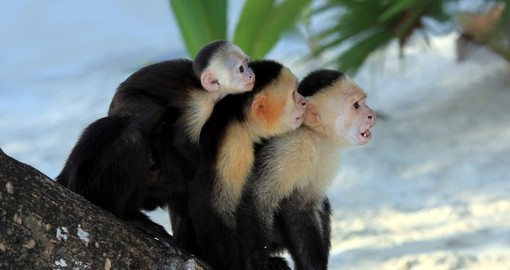
Take a boat trip along the winding canals of the Cuero y Salado Wildlife Refuge, which provides a habitat for numerous animal species, including monkeys, alligators and manatees, and dozens of water birds.
Try canopy touring: a series of cables are fixed from tree to tree and, attached to a pulley while wearing a harness, you can fly through the canopy of the rainforest.
Reel them in! There is good fishing on both coasts and Lake Yojoa offers some of the best bass fishing in the world.
Scuba-dive in the crystalline water and pristine coral reefs of the Bay Islands. The islands are one of the worlds top certification destinations. For those already certified, there are courses in underwater photography, cave diving and instructor training.
Experience some of Central Americas best white-water rafting along the Cangrejal River, near La Ceiba.
Things to See
Admire the view across Tegucigalpa, the temperate capital city, from the site of the city's most recent monument, Christ of the Picacho, set atop a mountain. Be sure to take a look around the city itself too, especially the old historical centre.
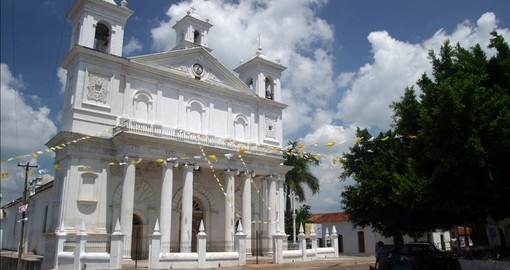
Seek heritage and history in Comayagua, former capital of Honduras and now a colonial masterpiece of cobbled streets, tiny plazas and whitewashed houses. The best time to visit is during the unique and fervent celebrations of Easter week.
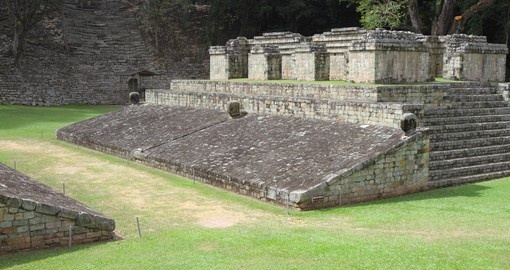
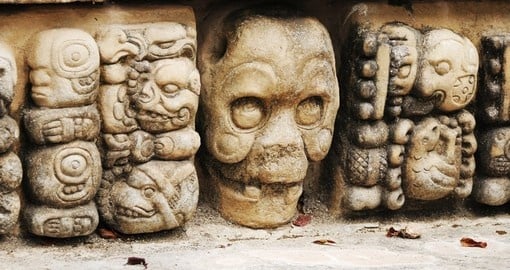
See the ancient city of Copán. The Copán Ruins Archaeological Park is the best remaining testament to the culture of the Mayan Indians. Among the best of the ruins are the magnificent Acropolis, the Great Plaza, and the Court of the Hieroglyphic Stairway.
Play at being a pirate in Trujillo on Honduras gorgeous Caribbean coast. Once a thriving port and the old capital of colonial Honduras, Trujillo is today home to many old Spanish buildings, a fascinating pirate history and superb tropical beaches.
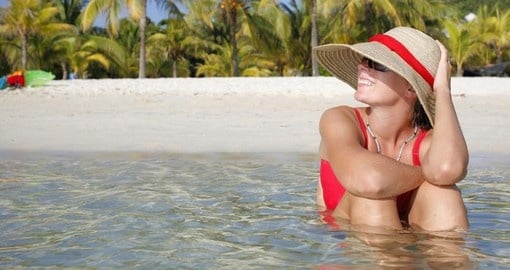
Make a splash in the exotic archipelago of the Bay Islands. Hilly, tropical Guanaja and Roatán are protected by a great coral reef. Utila has wide sandy beaches ringed by tiny cays surrounded by palm trees. There are several smaller islands.
Get back to nature: wildlife refuges and national parks all over the country offer an exciting, unspoilt landscape and multitude of flora and fauna. Cloud forests, mountains, dry forests, pine forests, coastal wetlands and huge rivers are there to be enjoyed.
DETAILS - CANADA |
DETAILS - US |
|---|---|
| All travelers will need a passport valid for at least 90 days following your departure date. However, we strongly recommend traveling with 6 months validity on your passport at all times. Citizens of Canada can refer to www.passport.gc.ca for forms and instructions for new passport applications and Canadian passport renewals. | All travelers will need a passport valid for at least 90 days following your departure date. However, we strongly recommend traveling with 6 months validity on your passport at all times. |
2 itineraries are available for Honduras
Email: info@goway.com • Accessibility at Goway • Privacy Policy
Booking Conditions Travel Insurance • Careers • Contact Us • Brochures •