
Venezuela
Venezuela Travel Packages

BUCKET LIST

VENEZUELA ITINERARIES

LATIN AMERICAN DESTINATIONS

Venezuela trips

HOLIDAYS OF A LIFETIME

Trekking, walking, wildlife encounters, cycling, rafting, sailing, cruising, camping, safaris, overland journeys and more.

Latin America Brochure
World of Adventure Brochure

GET A FREE TRAVEL QUOTE

Request a free travel quote from Goway

or call 1-800-387-8850

Venezuela

Country General Information

Inquire about this trip
Get A Brochure

Though best known for its oil politics and feisty president, Venezuela is in fact an action-packed traveller's destination endowed with an astonishing array of landscapes and experiences. Tropical beaches, vast wetlands, great rivers, idyllic colonial towns, little-explored jungle and majestic mountains are among the South American country's varied settings. Visitors can choose from a wealth of adventure activities or just kick back and enjoy the resort experience.

Venezuela is an amazingly diverse country: from the peaks of the Andes to the long stretches of sunny beach, the beautiful Caribbean islands, the hustle and bustle of busy Caracas to the vast areas of Amazon rain-forest - whether you are visiting Venezuela purely for pleasure or as part of a business trip, Goway hopes to help you make your visit a great one.


  • Country Facts
  • Climate
  • Money
  • Food & Drinks
  • Travel Info
  • Passport & Visas

Area

912,050 km² (352,144 sq miles)

Population

27,635,743 (July 2011 est.)

Population density

30.2 per km²

Capital

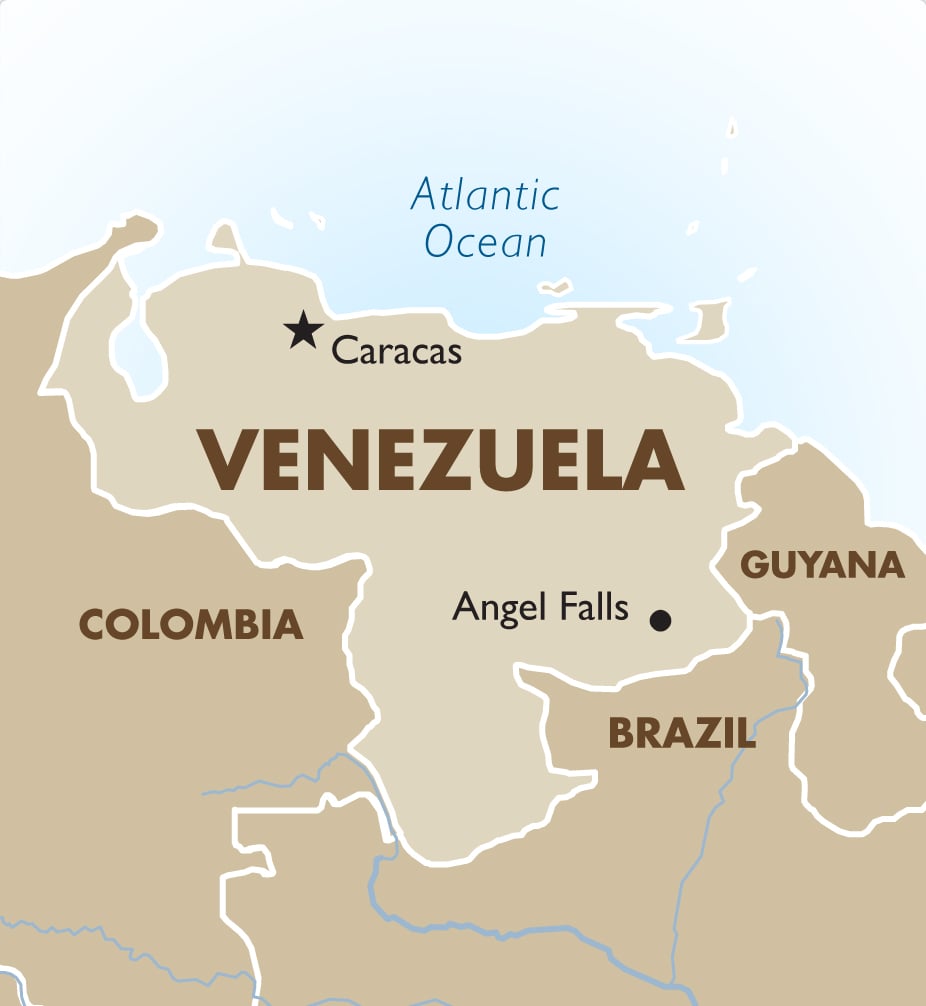
Caracas. Population: 4.3 million (metropolitan area, 2008)

Government

Republic. Gained independence from Spain in 1830.

Geography

Venezuela is bordered to the north by the Caribbean, to the east by Guyana and the Atlantic Ocean, to the south by Brazil, and to the west and southwest by Colombia. The country consists of four distinctive regions: the Venezuelan Highlands in the west; the Maracaibo Lowlands in the northwest; the vast central plain of Los Llanos around the Orinoco River; and the Guyana region in the extreme south, which includes part of the Amazon rainforest and the Guyana highlands.

Language

Spanish is the official language. English, French, German and Portuguese are also spoken by some sections of the community.

Religion

96% Roman Catholic

Time

GMT - 4.5

Social Conventions

Shaking hands or using the local abrazo, a cross between a hug and a handshake, are the normal forms of greeting. In Caracas, conservative casual wear is the norm. Men are expected to wear suits for business, and jackets and ties are usual for dining out and social functions. Dress on the coast is less formal but beachwear and shorts should not be worn away from the beach or pool. Smoking follows European habits and in most cases it is obvious where not to smoke. Some public buildings are also non-smoking areas.

Electricity

110 volts AC, 60Hz. US-style two-pin plugs are the most commonly used fittings

Head of State

President

History

(With thanks to Lonely Planet)

It is generally believed that the first inhabitants of the Americas came from Siberia across the Bering Strait, spread over the North American continent, then moved down to Central and South America in several waves of migration. There is evidence of human habitation in northwest Venezuela going back more than 15, 000 years. Steady agriculture was established around the 1st millennium, leading to the first year-round settlements.

Formerly nomadic groups began to develop into larger cultures belonging to three main linguistic families: Carib, Arawak and Chibcha. By the time of the Spanish conquest at the end of the 15th century, some 300, 000 to 400, 000 indigenous people inhabited the region that is now Venezuela.

The warlike Carib tribes occupied the central and eastern coast, living off fishing and shifting agriculture. Various Arawak groups were scattered over the western plains and north up to the coast. They lived off hunting and food-gathering, and occasionally practiced farming.

The Timote-Cuica tribes, of the Chibcha linguistic family, were the most advanced of Venezuela’s pre-Hispanic societies. They lived in the Andes and developed advanced agricultural techniques, including irrigation and terracing. They were also skilled craftspeople, as we can judge by the artifacts they left behind – examples of their fine pottery are shown in museums across the country. No major architectural works have survived, though some smaller sites in the Andean region have recently been unearthed and will be opening for tourism in the next few years.

The spanish are coming!

In 1498, on his third trip to the New World, Christopher Columbus became the first European to set foot on Venezuelan soil. Columbus anchored at the eastern tip of the Península de Paria, just opposite Trinidad. He originally believed that he was on another island, but the voluminous mouth of the Río Orinoco hinted that he had stumbled into something slightly larger.

A year later, explorer Alonso de Ojeda, accompanied by the Italian Amerigo Vespucci, sailed up to the Península de la Guajira, at the western end of present-day Venezuela. On entering Lago de Maracaibo, the Spaniards saw the local indigenous people living in palafitos (thatched huts on stilts above the water). They called the land ‘Venezuela’ (literally ‘Little Venice’), perhaps as a sarcastic sailor joke as these rustic reed dwellings didn’t exactly match the opulent palaces of the Italian city they knew. The name of Venezuela appeared for the first time on a map in 1500 and has remained to this day. Laguna de Sinamaica is reputedly the place where the first Spanish sailors saw the palafitos, and you can see similar huts there today.

Alonso de Ojeda sailed further west along the coast and briefly explored parts of what is now Colombia. He saw local aborigines wearing gold adornments and was astonished by their wealth. Their stories about fabulous treasures inland gave birth to the myth of El Dorado (The Golden One), a mysterious land abundant in gold. Attracted by these supposed riches, the shores of Venezuela andColombia became the target of Spanish expeditions, an obsession with El Dorado driving them into the interior. Their search resulted in the rapid colonization of the land, though El Dorado was never found.

The Spanish established their first settlement on Venezuelan soil around 1500, at Nueva Cádiz, on the small island of Cubagua, just south of Isla de Margarita. Pearl harvesting provided a livelihood for the settlers, and the town developed into a busy port until an earthquake and tidal wave destroyed it in 1541. The earliest Venezuelan town still in existence, Cumaná, on the northeast coast, dates from 1521 and is an enjoyable place to visit, even though earthquakes ruined much of the early Spanish colonial architecture.

Officially, most of Venezuela was ruled by Spain from Santo Domingo (present-day capital of the Dominican Republic) until 1717, when it fell under the administration of the newly created viceroyalty of Nueva Granada, with its capital in Bogotá.

The colony’s population of indigenous communities and Spanish invaders diversified with the arrival of black slaves, brought from Africa to serve as the workforce. Most of them were set to work on plantations on the Caribbean coast. By the 18th century, Africans surpassed the indigenous population in number.

Out from under the yoke

With few exploited gold mines, Venezuela lurked in the shadows of the Spanish Empire for its first three centuries. The country took a more prominent role at the beginning of the 19th century, when Venezuela gave Latin America one of its greatest heroes, Simón Bolívar.

Francisco de Miranda lit the initial revolutionary flame in 1806. However, his efforts to set up an independent administration in Caracas ended when fellow conspirators handed him over to the Spanish. He was shipped to Spain and died in jail. Bolívar then assumed leadership of the revolution. After unsuccessful initial attempts to defeat the Spaniards at home, he withdrew to Colombia, then to Jamaica, until the opportune moment came in 1817.

The Napoleonic Wars had just ended, and Bolívar’s agent in London was able to raise money and arms, and recruit a small number of British Legion veterans of the Peninsular War. With this force and an army of horsemen from Los Llanos, Bolívar marched over the Andes and defeated the Spanish at the Battle of Boyacá, bringing independence to Colombia in August 1819. Four months later in Angostura (present-day Ciudad Bolívar), the Angostura Congress proclaimed Gran Colombia (Great Colombia), a new state unifying Colombia, Venezuela and Ecuador (though the last two were still under Spanish rule). The memories of the event are still alive in Ciudad Bolívar, and you can see the great mansion where the first congress debated. Venezuela’s liberation came on June 24, 1821 at Carabobo, where Bolívar’s troops defeated the Spanish royalist army.

Though the least important of Gran Colombia’s three provinces, Venezuela bore the brunt of the fighting. Venezuelan patriots fought not only on their own territory, but also in the armies that Bolívar led into Colombia and down the Pacific Coast. By the end of 1824, Bolívar and his assistants had liberated EcuadorPeru and Bolivia. It’s estimated that a quarter of the Venezuelan population died in the independence wars.

Great colombia & greater problems

Bolívar’s dream of a unified republic fell apart even before he died in 1830. On his deathbed, he proclaimed: ‘America is ungovernable. The man who serves a revolution plows the sea. This nation will fall inevitably into the hands of the unruly mob and then will pass into the hands of almost indistinguishable petty tyrants.’ Unfortunately, he wasn’t far off the mark. GranColombia began to collapse from the moment of its birth; the central regime was incapable of governing the immense country with its racial and regional differences. The new state existed for only a decade before splitting into three separate countries.

Following Venezuela’s separation from Gran Colombia, the Venezuelan congress approved a new constitution and – incredibly – banned Bolívar from his homeland. It took the Venezuelan nation 12 years to acknowledge its debt to the man to whom it owed its freedom. In 1842, Bolívar’s remains were brought from Santa MartaColombia, where he died, to Caracas and entombed in the cathedral. In 1876 they were solemnly transferred to the Panteón Nacional in Caracas, where they now rest in a bronze sarcophagus.

Enter the era of ‘indistinguishable petty tyrants.’ The post-independence period in Venezuela was marked by serious governmental problems that continued for more than a century. These were times of despotism and anarchy, with the country being ruled by a series of military dictators known as caudillos.

The first of the caudillos, General José Antonio Páez, controlled the country for 18 years (1830–48). It was a tough rule, but it established a certain political stability and put the weak economy on its feet. The period that followed was an almost uninterrupted chain of civil wars that was only stopped by another long-lived dictator, General Antonio Guzmán Blanco (1870–88). He launched a broad program of reform, including a new constitution, and assured some temporary stability, but his despotic rule triggered wide, popular opposition, and when he stepped down the country plunged again into civil war.

In the 1840s, Venezuela raised the question of its eastern border with British Guiana (present-day Guyana), claiming as much as two-thirds of Guiana, up to the Río Esequibo. The issue was a subject of lengthy diplomatic negotiations and was eventually settled in 1899 by an arbitration tribunal, which gave rights over the questioned territory to Great Britain. Despite the ruling, Venezuela maintains its claim to this day. All maps produced in Venezuela have this chunk of Guyana within Venezuela’s boundaries, labeled ‘Zona en Reclamación.’

Another conflict that led to serious international tension was Venezuela’s failure to meet payments to Great BritainItaly and Germany on loans accumulated during the government of yet another caudillo, General Cipriano Castro (1899–1908). In response, the three European countries sent their navies to blockade Venezuelan seaports in 1902.

The national soap opera

The first half of the 20th century was dominated by five successive military rulers from the Andean state of Táchira. The longest lasting and most tyrannical was General Juan Vicente Gómez, who seized power in 1908 and didn’t relinquish it until his death in 1935. Gómez phased out the parliament, squelched the opposition and monopolized power.

The discovery of oil in the 1910s helped the Gómez regime to put the national economy on its feet. By the late 1920s, Venezuela was the world’s largest exporter of oil, which not only contributed to economic recovery but also enabled the government to pay off the country’s entire foreign debt. As in most petro-states, almost none of the oil wealth made its way to the common citizen. The vast majority of Venezuelans continued to live in poverty with little or no educational or health facilities, let alone reasonable housing. Fast oil money also led to the neglect of agriculture and to the development of other types of production. It was easier to just import everything from abroad, which worked for a while, but proved unsustainable.

Tensions rose dangerously during the following dictatorships, exploding in 1945 when Rómulo Betancourt, leader of the left-wing Acción Democrática (AD) party, took control of the government. A new constitution was adopted in 1947, and noted novelist Rómulo Gallegos became president in Venezuela’s first democratic election. The inevitable coup took place only eight months after Gallegos’ election, with Colonel Marcos Pérez Jiménez emerging as the leader. Once in control, he smashed the opposition and plowed oil money into public works and built up Caracas. He superficially modernized the country but the mushrooming development did not heal the country’s economic and social disparities, nor the bitter resentment that lingered from the coup.

The boom/bust cycle

Pérez Jiménez was overthrown in 1958 by a coalition of civilians and navy and air-force officers. The country returned to democratic rule and Rómulo Betancourt was elected president. He enjoyed popular support and actually completed the constitutional five-year term of office – the first democratically elected Venezuelan president to do so. Since then, all changes of president have been by constitutional means, although the last decade has seen a few hiccups.

During the term of President Rafael Caldera (1969–74), the steady stream of oil money flowed into the country’s coffers keeping the economy buoyant. President Carlos Andrés Pérez (1974–79) benefited from the oil bonanza – not only did production of oil rise but, more importantly, the price quadrupled following the Arab-Israeli war in 1973. In 1975 Pérez nationalized the iron-ore and oil industries and went on a spending spree; imported luxury goods crammed shops and the nation got the impression that El Dorado had finally materialized.

In the late 1970s, the growing international recession and oil glut began to shake Venezuela’s economy. Oil revenues declined, pushing up unemployment and inflation, and once more forcing the country into foreign debt. The 1988 drop in world oil prices cut the country’s revenue in half, casting doubt on Venezuela’s ability to pay off its debt. Austerity measures introduced in 1989 by Pérez Jiménez (elected for the second time) triggered a wave of protests, culminating in the loss of more than 300 lives in three days of bloody riots known as ‘El Caracazo.’ Further austerity measures sparked protests that often escalated into riots. Strikes and street demonstrations continued to be part of everyday life.

To make matters worse, there were two attempted coups d’état in 1992. The first, in February, was led by paratrooper Colonel Hugo Chávez. Shooting throughout Caracas claimed more than 20 lives, but the government retained control. Chávez was sentenced to long-term imprisonment. The second attempt, in November, was led by junior air-force officers. The air battle over Caracas, with war planes flying between skyscrapers, gave the coup a cinematic, if not apocalyptic, dimension. The Palacio de Miraflores, the presidential palace, was bombed and partially destroyed. The army was called to defend the president, and this time more than 100 people died.

Corruption, bank failures and loan defaults plagued the government through the mid-1990s. In 1995, Venezuela was forced to devalue the currency by more than 70%. By the end of 1998, two-thirds of Venezuela’s 23 million inhabitants were living below the poverty line. Drug-trafficking and crime had increased and Colombian guerrillas had dramatically expanded their operations into Venezuela’s frontier areas.

Veering to the left

There is nothing better in political theater than a dramatic comeback. The 1998 election put Hugo Chávez, the leader of the 1992 failed coup, into the presidency. After being pardoned in 1994, Chávez embarked on an aggressive populist campaign: comparing himself to Bolívar, promising help (and handouts) to the poorest masses and positioning himself in opposition to the US-influenced free-market economy. He vowed to produce a great, if vague, ‘peaceful and democratic social revolution.’

Since then, however, Chávez’ ‘social revolution’ has been anything but peaceful. Shortly after taking office, Chávez set about rewriting the constitution. The new document was approved in a referendum in December 1999, granting him new and sweeping powers. The introduction of a package of new decree laws in 2001 was met with angry protests, and was followed by a massive and violent strike in April 2002. It culminated in a coup d’état run by military leaders sponsored by a business lobby, in which Chávez was forced to resign. He regained power two days later, but this only intensified the conflict.

While the popular tensions rose, in December 2002 the opposition called a general strike in an attempt to oust the president. The nationwide strike paralyzed the country, including its vital oil industry and a good part of the private sector. After 63 days, the opposition finally called off the strike, which had cost the country 7.6% of its GDP and further devastated the oil-based economy. Chávez again survived and claimed victory.

The chávez era

National politics continued to be shaky until Chávez won a 2004 referendum and consolidated his power. Emboldened by greater political support and his pockets swollen by high oil prices, Chávez quickly moved to expand his influence beyond the borders of Venezuela, reaching out to other Leftist leaders in BoliviaArgentina, Cuba, UruguayChile and Brazil. He has openly allied himself with Cuba’s Fidel Castro, supported the successful Leftist candidacy of Bolivia’s Evo Morales and Leftist candidates in Peru and Mexico who did not win office. Not afraid to make his opinion heard, Chávez also called former Mexican President, and free-trade supporter, Vicente Fox a ‘puppy dog of the (US) empire.’

Chávez hopes to establish a Latin American political bloc to offer an alternative to US hegemony in the region. He made an international reputation for himself with his outspoken opposition to US president George W Bush and the proposed Free Trade Area of the Americas (FTAA) at the 2005 Summit of the Americas in Mar del Plata, Argentina.

In 2005, shortly after Caracas hosted the 6th World Social Forum, Chávez started a highly publicized and dubiously intentioned program to provide reduced-priced heating oil for impoverished people in the US. The program was expanded in 2006 to include four of New York City’s five boroughs, providing 25 million gallons of fuel for low-income New Yorkers at 40% off the wholesale price. While the program obviously aided hundreds of thousands of poor New Yorkers, it was used as a political jab to Chávez’ enemy Bush.

In 2006, Chávez announced Venezuela’s bid to win the Latin American and Caribbean nonpermanent seat on the UN Security Council. The US encouraged other nations to vote for Guatemala instead. Chávez tried to get China to intervene by offering discounted oil, but the voting arrived at a stalemate. Panama was chosen as a consensus candidate and claimed the council seat, though Venezuela clearly felt sabotaged by the US.

On September 20, 2006, Chávez addressed the UN General Assembly. In the speech, he referred to Bush as ‘the devil, ’ adding that Bush (who had delivered a speech to the UN the day before), had come ‘to preserve the current pattern of domination, exploitation and pillage of the peoples of the world.’

The end of 2006 was enveloped in the lead-up to the December 3 presidential election. Chávez’ closest challenger, Manuel Rosales, accused the president of providing impractical political favors and aid to other countries while poverty and crime increased at home, and also challenged Chávez’ government-approved land takeovers (for redistribution to the landless) and the military build-up for a hypothetical US invasion. Chávez wrote Rosales off as a lackey for the US and refused to debate him on TV.

Chávez again won the national election with 63% of the vote and was thereby elected to another six-year term. The Organization of American States and the Carter Center certified the results. After his victory, Chávez promised a more aggressive turn toward socialism and, at the time of writing this book, has made moves to nationalize the telecommunications (CANTV) and electrical industries. He is also asking to eliminate the autonomy of the Central Bank and dissolve many opposition political parties and opposition media outlets. Chávez has made no secret of the fact that he plans to amend the national constitution so that he can run for president again in 2012.

Read more: http://www.lonelyplanet.com/venezuela/history#ixzz1nbnD3tgz

Climate

The climate varies according to altitude. Lowland areas have a tropical climate, while mountainous regions are significantly cooler. Pack a sweater or jacket if you're planning to spend any time in the Andes. The rainy season runs from May to December. During this period, there is the possibility of flooding in certain low-lying areas, such as the Llanos and in some valleys of the Andes. Various parts of Venezuela, including Caracas and the eastern part of Sucre, are vulnerable to earthquakes, although there have been no serious ones for many years.

Currency

Bolívar Fuerte (VEF; symbol Bs.F.) = 100 céntimos.

Notes are in denominations of Bs.F.100, 50, 20, 10, 5 and 2; coin denominations are Bs.F.1, and 50, 25, 12.5, 10, 5 and 1 céntimos.

Currency Exchange

Banks and casas de cambio (exchange offices) will exchange cash; some, such as Italcambio, convert traveller's cheques as well. Higher-end hotels can also change money, though often at a less favourable rate. Travellers are advised to bring currency in US Dollars.

Credit / Debit Cars

MasterCard, Visa and American Express are accepted in the main cities and tourist centres. Most major banks have ATMs.

Travelers Cheques

Widely accepted, although one may be asked to produce a receipt of purchase. American Express is the standard; other types of traveller's cheques may not be accepted. A commission of 3% or more is charged. To avoid additional exchange rate charges, take traveller's cheques in US Dollars.

Banking Hours

Mon-Fri 0830-1530

Food and Drink

The distinctive flavour of comida criolla, as Venezuela's cuisine is locally known, resides in roots and vegetables: yams, yucca, plantains and beans. Beef from the cattle ranches of Los Llanos also figures prominently; it's done a la parrilla (charcoal grilled) at the country's many steakhouses. Equally enticing are the varieties of fresh fish and seafood stews prepared along the Caribbean coast.

Authentic Italian, Chinese, Spanish and Middle Eastern cuisines are also widely available, thanks to the presence of substantial immigrant communities. From pineapples to papayas, tropical fruit is fabulously varied and blended into batidos (shakes). Venezuela produces excellent rum and is a major importer of Scotch. Polar (served ice-cold, naturally) is the most popular of several local beers.

National specialties

Arepas (corn cakes generously stuffed with all manner of fillings).

Pabellón criollo (shredded meat served with fried plantains, black beans and rice and a slab of cheese).

Hallaca (corn dough filled with beef, pork, olives, etc, and steamed in banana leaves; a Christmas favourite).

Cachapas (slightly sweet corn pancakes, usually folded over hunks of white cheese and/or ham).

Hervido (hearty soup of beef, chicken or fish with root vegetables).

National drinks

Coffee (espresso style - specify café marrón for milk).

Merengadas (fruity milkshakes).

Chicha (sweet and creamy rice-based drink).

Papelón con limon (refreshing beverage of sugar cane juice and lemon).

Tipping

In most bars and restaurants, 10% is added to the bill; at fancier establishments it's customary to leave an additional 10% on the table.

Nightlife

Venezuelans are fond of their rumba (revelry), and after-hours entertainment is a highly developed art. The evening's activities usually get started with a couple of cold Polars or rum cocktails at a bar, followed up by a night of dancing. Most discos cover the musical spectrum from salsa to Latin pop, while the more youth-oriented venues tend toward rock and reggaetón.

The capital, Caracas, boasts the country's most hedonistic nightlife scene, with multi-hall clubs thumping through the night, but most towns of any significant size will have a disco or two. For a less frenetic night out, stately old theatres in Caracas, Maracaibo, Maracay and Valencia feature classical music, opera, ballet, and (if your Spanish is up to it) plays. Cinemas, often located in shopping malls, generally feature recent Hollywood fare with Spanish subtitles.

Public Holidays

1 Jan New Year's Day; 13-16 Feb Carnival; 1 Apr Holy Thursday; 2 Apr Good Friday; 19 Apr Declaration of Independence; 1 May Labour Day; 24 Jun Battle of Carabobo; 5 Jul Independence Day; 24 Jul Birth of Simón Bolívar; 12 Oct Day of Indigenous Resistance; 25 Dec Christmas Day.

Things to Do

Try mountain trekking or rock climbing in the Sierra Nevada de Mérida, where several of the country's highest peaks are located. Experienced guides and equipment can be hired in Mérida, the regional tourist hub.

Ride the world's longest and highest cable car (teleférico), which runs 12.6km (7.9 miles) from Mérida to the top of Pico Espejo (4,765m/15,629ft), providing easy access to starting points for mountain treks.

Snorkel or dive at Parque Nacional Mochima (website: www.inparques.gob.ve) on the northeast coast, with dozens of offshore islands and islets, some - like the popular Isla de Plata - surrounded by coral reefs. The archipelago Los Roques is another underwater wonderland.

Cruise through the mangrove caños (channels) of Parque Nacional Morrocoy (website: www.inparques.gob.ve) in the northwest, or sail out to the park's chain of islands, renowned for their paradisiacal beaches and flocks of flamingos.

Burrow down into the Cueva del Guácharo, the most spectacular of Venezuela's many cave systems, and thrill to the eerie screeching of thousands of guácharos (oilbirds), a type of nocturnal bird that inhabits the subterranean dwelling.

Enjoy the novelty of skiing in the tropics. The peaks of the Cordillera de Mérida have a permanent snowline and can be skied between November and June, though at an altitude of 4,270m (14,000ft) this is recommended only for the hardiest.

Train your binoculars on hummingbirds, herons, tanagers, toucanets, curassows and hundreds of other exotic bird species at the Parque Nacional Henri Pittier, a birdwatchers' haven on the central northern coast. See www.birdvenezuela.com for more information on twitching in Venezuela.

Swim, sun yourself, savour superb seafood and generally unwind at the coastal resorts of Isla de Margarita, Venezuela's largest Caribbean isle with 168km (104 miles) of beaches. There are daily air-shuttles from Maiquetía airport to Porlamar, Margarita's principal town, and ferries from several mainland ports.

Go deep-sea fishing off La Guaira, where the plankton-rich El Placer bank is renowned for its extraordinarily abundant blue marlin, white marlin and sailfish. Anglers can also hook bonefish in the Archipelago Los Roques and even piranhas in the rivers of Los Llanos.

Things to See

Explore the capital, Caracas, a modern metropolis in a stunning setting along the base of the Ávila range. Besides a fabulously varied culinary landscape, a vibrant cultural life and throbbing nightlife scene, the city also boasts an array of world-class museums.

Take a scenic flight or motorised canoe trip to the foot of Angel Falls(Salto ángel), the world's highest waterfall, in the southeast, with an uninterrupted drop of 979m (3,212ft). The two-day canoe trip operates from June to November.

Admire large colonies of pink flamingos and scarlet ibis at Parque Nacional Morrocoy (website: www.inparques.gob.ve), a coastal refuge about four hours north of Caracas. Best glimpsed in September, the flamboyant fowl congregate in the lagoons near Chichiriviche and along the mangrove canals.

Catch a display of joropo, Venezuela's national dance, in Los Llanos, the vast plains region where it originated. The flamenco-influenced step is accompanied by ensembles playing harp, guitar and maracas and singing in a high-pitched nasal style.

Take a tour from Maracaibo north to the Guajira peninsula, where the indigenous Wayúu (or Guajiro) people live much as they did when the first Spanish settlers arrived, dwelling in houses that are raised above the lake on stilts (website: www.wayuutaya.org).

Get to know Mérida, a delightful university town perched amidst snow-capped Andean peaks. More than just an excellent base for hiking, wildlife watching and white-water rafting, Mérida boasts several fine art and archaeology museums and a vibrant nightlife.

Linger in the beautifully preserved center of Coro, an early colonial settlement near the Caribbean coast that's on UNESCO's list of World Heritage Sites. Aside from its historical legacy, it's also the gateway to the Paraguaná Peninsula, a prime windsurfing destination.

Behold the eerie majesty of Mount Roraima, the inspiration for Sir Arthur Conan Doyle's The Lost World. Tallest of the south-eastern Gran Sabana region's tepuis - flat-topped sandstone mountains - it is a habitat for various endemic flora and fauna.

Marvel at the magical natural phenomenon of lightning minus the accompanying thunderclap at the Parque Nacional Ciénagas del Catatumbo, along a river delta southwest of Lake Maracaibo. The highly unusual displays can be witnessed throughout the year.

Check out Colonia Tovar, a slice of Deutschland in the forested mountains west of Caracas. Settled by German immigrants from the Black Forest in the mid-19th century, the town retains its Old World traditions, food and architecture, making for a surreal excursion from the capital (website: www.coloniatovar.net).

DETAILS - CANADA

DETAILS - US

All travelers will need a passport valid for at least 90 days following your departure date. However, we strongly recommend traveling with 6 months validity on your passport at all times. Citizens of Canada can refer to www.passport.gc.ca for forms and instructions for new passport applications and Canadian passport renewals. All travelers will need a passport valid for at least 90 days following your departure date. However, we strongly recommend traveling with 6 months validity on your passport at all times.

2 itineraries are available for Venezuela


Consumer Protection Agency Logos Goway Travel is a BBB Accredited Business.