
BUCKET LIST
BELIZE CITY STOP OVERS
- Belize City Stop Over, 3 days
BELIZE ITINERARIES
- Almond Beach Resort
- Pelican Beach Dangriga
- Pelican Beach South Water Caye
- Tikal & Belizean Adventure, 9 days
- Tikal Overnight, 2 days
BELIZE LODGES AND RESORTS
- Cayo Espanto, Belize Barrier Reef
- Hidden Valley Inn
- Jaguar Reef Lodge
- Ka'ana Boutique Luxury Resort
- Pelican Beach Dangriga
- Pelican Beach South Water Caye
- Placencia Hotel
- Ramons Village Resort
- Robert's Grove
- Sun Breeze Hotel
- Victoria House
LATIN AMERICAN DESTINATIONS
- Antarctica (12 trips)
- Argentina (28 trips)
- Belize (6 trips)
- Bolivia (10 trips)
- Brazil (28 trips)
- Chile (30 trips)
- Colombia (9 trips)
- Costa Rica (7 trips)
- Ecuador (14 trips)
- El Salvador (4 trips)
- Falkland Islands (2 trips)
- Galapagos (14 trips)
- Guatemala (7 trips)
- Honduras (2 trips)
- Panama (6 trips)
- Peru (36 trips)
- Uruguay (3 trips)
- Venezuela (2 trips)

HOLIDAYS OF A LIFETIME
- Splendours of South America (2012), 17 days
- Splendours of South America (2013), 15 days
- Magical Ecuador and Peru (2012), 20 days
- Magical Ecuador and Peru plus Bolivia (2013/2014), 23 days
- Best of Ecuador, 11 days
- Cradle of the Incas, 13 days
Trekking, walking, wildlife encounters, cycling, rafting, sailing, cruising, camping, safaris, overland journeys and more.
Latin America Brochure
World of Adventure Brochure
GET A FREE TRAVEL QUOTE
Belize
Country General Information
The Long Count Calendar of the Ancient Mayans ends on Dec 21 2012.
What does that mean? Your guess is a good as anybodies as the variations in hypothesis is as varied as the region in which the Mayan inhabited at the peak of their civilization.
Occupying the Yucatan peninsula and what is modern day Mexico, El Salvador, Honduras and Guatemala the civilization came into being 2000 BC reaching its zenith between 250 and 900 AD the Mayans the fist pre Colombian society to have a fully developed written language as well as complete and complicated mathematical and astronomical systems. This astronomical system or calendar (Long Count Calendar) and the end of one cycle is what all the fuss is about as we approach 2012.
Though the Mayans have calculated that the date of December 21st, 2012 A.D. (13.0.0.0.0 in the Long Count) marks the end of a cycle and a beginning of a new one - they did not stipulate or predict what this ending and new beginning may denote.
There are generally two schools of thought. One is a more holistic spiritual view where we see simply see the ending of one phase and the beginning of a new.
The other is the more "Hollywood view" where a catastrophic event may take place with some evening predicting the end of the world as we know it.
Despite what view you may ascribe to, in 2012 there is an amazing coinciding of mother natures "pieces" falling in to place and alignment.
"The date December 21st, 2012 A.D. (13.0.0.0.0 in the Long Count Winter Solstice Sun with the crossing point of the Galactic Equator (Equator of the Milky Way) and the Ecliptic (path of the Sun), what that ancient Maya recognized as the Sacred Tree."
Many of the famous Mayan sites in and around the Yucatan peninsula display images of the Milky Way and the Sacred Tree motif it being a vital part of the Mayans belief.
This crossing of the Galactic equator and the path of sun represents to the Mayans a sacred doorway where a human being enters into life, and enters or exits into death as well.
The web is a buzz with all different theories as to what will happen in 2012 as well as detailed recounting of the histories and structures of the astronomical calendars and the history and records of the Mayan.
So if you believe great physical change will take place in 2012 travel now and be at the "source" of a global change. More a believer in the spiritual transformation then plan your journey for 2012 or even plan to be there Dec 21st 2012.
No matter what happens Goway will be there with our fantastic itinerary taking in the best of modern day and ancient Mayan culture - 10 day World of the Maya - visiting El Salvador, Honduras and Guatemala with great opportunities to extend your journey in to Belize or south to Costa Rica and or Panama.
With departures every Wednesday or Saturday you will visit local workshops witnessing handicraft techniques dating back to Mayan times as well Copan ruins in Honduras and Tikal as well as the famous markets of Chichicastenango and Antigua de Guatemala in Guatemala.
Want to be in the heart of the Mayan World - Tikal - on December 21st then join our dedicated World of the Maya departure 15th December 2012.*
Also on offer are itineraries such as the Best of Guatemala 8 days, Tikal & Belizean Adventure, 9 days or Honduras in Depth 9 days.
Change is good, change is healthy but travel is priceless. Join us and venture into one of the great mysteries as it plays itself out in our life time in the "World of the Maya".
*Conditions apply
- Country Facts
- Climate
- Money
- Food & Drinks
- Travel Info
- Passport & Visas
Area
22880sq km (8803 sq miles)
Population
333,200
Population density
15 per km.
Capital
Belize City
Government
Geography
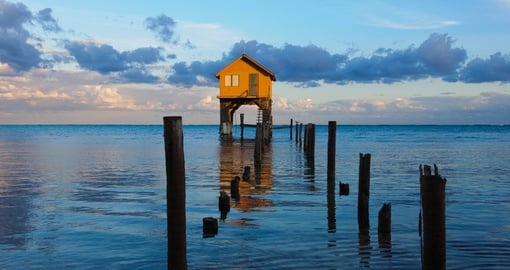
With one foot planted in the Central American jungles and the other dipped in the Caribbean Sea, Belize blends the best of both worlds. Offshore, kayakers glide from one sandy, palm-dotted islet to another, while snorkelers swim through translucent seas, gazing at a kaleidoscope of coral, fish, dolphins and turtles. Inland, explorers investigate ruins of ancient civilizations, and birders aim their binoculars at some 570 species. Between national parks, wildlife sanctuaries and marine reserves, more than 40% of the country’s area is protected in one form or another, creating a haven for countless creatures of land, sea and sky.
Belize attracts more than 850,000 annual visitors eager to explore the mysteries of Maya sites such as Altun Ha or Lamanai, spot a toucan in the bird-watcher's paradise that is Crooked Tree Wildlife Sanctuary, snorkel the reef off Caye Caulker or the Northern Cayes, and otherwise partake of paradise. Tourism is the country’s top source of employment and investment. The irony is that it is also the country’s biggest environmental threat.
Belize does not yet have the infrastructure to support the massive numbers of tourists that arrive, especially by way of cruise ships. It does not have the resources to truly protect its sanctuaries and reserves and their inhabitants. And it does not have the political will to stop the rampant coastal development, which would mean turning down millions in investment dollars. According to sources such as Tropical Conservation Science, as much as 80% of coastal land has already been sold to foreign interests with the intention of building condos and resorts.
Fortunately, Belizeans are environmentally aware and indefatigably active. Thanks to a progressive populace, Belize offers myriad ways for travelers to tread lightly, from beach resorts powered by solar energy to jungle lodges built from reclaimed hardwoods. Licensed guides not only direct, but also educate their clients – about the fragility of the reef, the medicinal uses of flora and the threats to the jaguar’s habitat. It’s never easy to maintain the delicate balance between preserving natural resources and cashing in on economic opportunity. But most Belizeans are proud of their natural heritage and they recognize that the goals of environmental conservation and economic prosperity are not mutually exclusive. This is the enlightened approach that has earned Belize its reputation as a paradigm of ecotourism.
Sub Umbra Florero reads the motto on the Belizean flag. It refers to the mighty mahogany tree, and it means ‘Under the shade, I flourish.’ The mahogany may not be as prevalent as it once was, but with its loss has come an understanding of its value. Belizeans recognize that their country’s greatest asset must be respected and protected, and that tourists have an important role to play.
It’s no wonder that Belizeans extend such a warm welcome to travelers. These easy-going people are eager to share – the staggering scenery, the bountiful biodiversity, all that exists in the shade of the mahogany tree.
Language
The official language is SpanishEnglish is often spoken by a small number of officials and businesspeople in commercial centres.
Religion
Primarily Roman Catholic with a Protestant minority and indigenous beliefs.
Time
GMT - 4
Social Conventions
Normal social courtesies in most Bolivian families and respect for traditions should be observed. Remember to refer to rural Bolivians as campesinos rather than Indians, which is considered an insult. Female campesinos still adhere to their traditional dress. A suit and tie for men and dress for women should be worn for smart social occasions. Casual wear is otherwise suitable. Smoking is accepted unless indicated otherwise. Time keeping is poor.
Electricity
110 and 220 volts AC, 50Hz. European two-pin (circular) plugs or US-style, two-pin (perpendicular flat) plugs.
Head of State
President
History
(With thanks to Lonely Planet)
Belize hosted one of the great Mesoamerican civilizations of ancient times, the Maya. The Maya created vibrant commercial centers, monumental religious temples and exquisite art works. They possessed sophisticated knowledge about their earthly and cosmological environments, much of which they wrote down. The Maya thrived from roughly 2000 BC to AD 1500, before succumbing to domestic decline and alien assault. The stone foundations of their lordly realm became a lost world submerged beneath dense jungle.
The Maya ranged across Central America, from the Yucatán to Honduras, from the Pacific to the Caribbean. They were not ethnically homogenous, but only loosely related, divided by kinship, region and dialect. The different communities sometimes cooperated and often competed with one another, building alliances for trade and warfare.
Archaeological findings indicate that Maya settlements in Belize were among the oldest. In the west, Cahal Pech, an important commercial center between the coast and interior, was dated to at least 1200 BC. In the north, majestic Lamanai, a major religious site for over 2000 years, was founded as early as 900 BC. In Belize today, three distinct Maya tribes still exist: the indigenous Mopan in the north; the Yucatec, who migrated from Mexico, also in the north; and, the Kekchi, who migrated from Guatemala, in the west and south.
The Maya were organized into kingdoms, in which social and economic life was an extension of a rigid political hierarchy. At the top were the king – or high lord – and his royal family, followed by an elite stratum of priests, warriors and scribes; next came economically valued artisans and traders; and finally, holding it all up were subsistence farmers and servant workers. The system rested on a cultural belief that the high lord had some influence with the powerful and dark gods of the underworld, who sometimes took the form of a jaguar when intervening in human affairs. This view was reinforced through the ruling elite’s elaborately staged power displays, a temple theater of awe.
Even before the germ-ridden Europeans arrived, the cultural underpinnings of Maya society were already coming undone. A prolonged drought had caused severe economic hardship, leaving the impression that the kings and priests had somehow lost their supernatural touch. It was left to the Spanish, however, to officially cancel the show.
Possibly the most impressive of the Maya kingdoms in Belize was at Caracol, in the western Pine Ridge Mountains. At its height, in the 6th and 7th centuries, Caracol was a major urban metropolis, with over 100, 000 residents. It boasted first-rate jewelers and skilled craftsmen, an intricately terraced agriculture system, a prosperous trading market, and 40 miles of paved roads (considerably more than it has today). According to the story carved by Maya artists into commemorative stone, the king of Caracol, Water Lord, defeated his chief rival, Double Bird, king of Tikal, in a decisive battle in AD 562, ushering in a long period of Caracol supremacy in the central highlands. The pictographic stone inscriptions also suggest that Water Lord personally sacrificed Double Bird to further emphasize the Caracol triumph. Perhaps this had something to do with the still-simmering feud between Belize and Guatemala.
In the 1500s, the jaguar kings were forced to take cover in the rainforest, when the sword-wielding Spanish arrived in Belize with the aim of plundering Maya gold and spreading the word of God. The Maya population of Belize at this time numbered about a quarter of a million, but their ranks were quickly decimated by as much as 90 percent, from the lethal combination of the diseases and greed of the Spanish. In the 1540s, a conquistador force based in the Yucatán set out on an expedition through much of present-day Belize, down the coast and across to the central highlands. Disappointed by the lack of riches uncovered, they left a bloody trail of slaughtered victims and abandoned villages in their wake. Religious sites, such as Lamanai, were forcibly converted to Catholicism.
In the early 1600s, the Maya finally staged a counter offensive that successfully drove out the few Spanish settlers and missionaries that had decided to stay. Weakened and fearful, the Maya did not return to the now desolate old cities, choosing instead to stay huddled in the remote interior.
Baymen of the Caribbean: British settlement When Columbus accidentally bumped into the continental landmass soon to be known as the Americas, his Spanish royal patrons had it made. Soon, Aztec gold and Incan silver overflowed in the king’s coffers, making Spain a transatlantic superpower. In 1494, the Treaty of Tordesillas established an exclusive Iberian claim on the region, declaring New World riches off-limits to old-world rivals. But the temptations were too great, and the hiding places too many. Spain’s spoils were set upon by British buccaneers, French corsairs and Dutch freebooters. In times of war, they were put into the service of their Crown as privateers; at other times, they were simply pirates.
Belize emerged as one of several Caribbean outposts for Britain’s maritime marauders. In the early 17th century, English sea dogs first began using the Bay of Honduras as a staging point for raids on Spanish commerce; henceforth the Brits in the region came to be known as Baymen.
The Belizean coast had several strategic advantages from a pirate’s perspective. The land was both bountiful and uninhabited as the Spanish had already driven the Maya out but never bothered to settle in themselves. It was just a short sail away from the heavily trafficked Yucatán Straits, where – if luck be with ye – the Treasure Fleet might be gathering in Havana or the Silver Train passing through on its way from Panama. And, the shoreline, concealed behind thick mangroves and littoral islands, offered protective cover, while the long barrier reef was a treacherous underwater trap that kept Spanish war galleons at a distance.
For the sake of historical record, the year 1638 was made the official founding date of a British settlement at the mouth of the Belize River. It was sometime around then that a Scottish pirate captain, Peter Wallace, decided to organize the building of a new port town. Legend has it that he laid the first foundations of what became Belize City with woodchips and rum bottles, presumably empty.
Meanwhile, the Baymen found yet another activity to annoy the Spanish king – poaching his rainforest. The settlement became a rich source of hardwoods, especially mahogany, much valued by carpenters, furniture-makers and shipbuilders back in Britain. In addition, the lowland forest was abundant in logwood trees, which provided a valuable dye extract used to make woolen textiles.
By the 18th century, Britain’s monarch finally had a navy and merchant fleet to match Spain’s. Privateers were no longer needed, and pirates were a nuisance. In 1765 Jamaican-based British naval commander Admiral Burnaby paid a visit to the rough-hewn Baymen and delivered a code of laws on proper imperial etiquette: thieving, smuggling and cursing were out; paying taxes and obeying the sovereign were in.
As the British settlement became more profitable, the Spanish king became more irritable. His armed forces made several unsuccessful attempts to dislodge the well-ensconced and feisty squatters. With the Treaty of Paris, in 1763, Spain instead tried diplomacy, negotiating a deal in which the Brits could stay and harvest wood as long as they paid rent to the Spanish Crown and promised not to expand the settlement. The Baymen did neither.
Spain finally got the better of the Baymen in 1779, burning down Belize City in a surprise attack and consigning the prisoners to slavery in Cuba. The conflict reached a decisive conclusion in 1798 at the Battle of St George’s Caye when a squadron of 30 Spanish warships was met and turned back by the alerted Baymen operating in smaller but faster craft. From this point, Spain gave up trying to boot the Brits from Belize. And the battle made such a good story that it eventually inspired a national holiday.
In living color: British Honduras In the 19th century, modern Belize began to take form, largely shaped by its economic role and political status in the Empire, where it was officially dubbed British Honduras. At first it was administered from Jamaica, but later was made a Crown Colony with its own appointed royal governor. Belizean society was an overlapping patchwork of British, African, Maya and Spanish influences. It was a haven for refugees and a labor camp for slaves, a multicultural but hierarchical Crown Colony in living color.
At the top of the colonial social order were the descendants of the Baymen. In earlier times, their outlaw ancestors comprised an ethnically mixed and relatively democratic community. But as the colony grew larger and ties with the Empire stronger, an oligarchy of leading families emerged. They may have descended from antiestablishment renegades, but now they were all about aristocratic manners. They touted their white, cultured British lineage, and used the Crown’s authority to reinforce their status. By order of His Majesty’s Superintendent for British Honduras, they alone were given political rights in colonial affairs and private entitlement to the forest and land. This elite colonial cohort managed to hold sway until the early 20th century.
As the economy was centered on timber exports, strong bodies were needed to perform the arduous labor of harvesting hardwoods from the dense rainforest. Like elsewhere in the Americas, African slaves provided the muscle, along with much sweat and pain. By 1800 the settlement numbered about 4000 in total: 3000 black slaves, 900 mixed-race coloreds and free blacks, and 100 white colonists. Slave masters could count, and acted shrewdly to stay on top. Male slaves were kept divided into small work teams based on tribal origins. They were forced to do long tours of duty in remote jungle camps, separated from other teams and from their families. Slave women performed domestic chores and farm work. Intraracial separation, however, did not mean interracial segregation, as mixed-race Creoles (descendents of African slaves) would eventually make up nearly 75% of the population.
In 1838 slavery was abolished in the British Empire. The plight of Afro-Belizeans, however, did not much improve. They were forbidden from owning land, which would have enabled them to be self-sufficient, and thus remained dependent on the white-controlled export economy. Instead of slaves, they were called ‘apprentices’ and worked for subsistence wages.
When the timber market declined in the 1860s, landowners diversified their holdings by introducing fruit and sugarcane. One persistent historical narrative has it that slave life in Belizean logging camps was more benign than the harsh conditions that existed on Caribbean sugar plantations. While this may be so, the facts remain that Belize experienced four major slave revolts between 1760 and 1820, and recorded high annual incidences of runaways, suggesting instead that repressive inhumanity may come in different packages.
Toward the mid-19th century, British colonists finally came into contact – and conflict – with the indigenous Maya. As loggers penetrated deeper into the interior, they encountered the elusive natives, who responded with hit-and-run assaults on the encroaching axmen.
At this time in the neighboring Yucatán Peninsula, an armed conflict broke out among the lowly Maya, second-class Mestizos and privileged Spanish-descended landlords. The bloody War of the Castes raged for over a decade and forced families to flee. Caste War refugees more than doubled the Belize population, from less than 10, 000 in 1845 to 25, 000 in 1861.
The movement of peoples redefined the ethnic character of northern Belize. Mestizo refugees, of mixed Spanish-Indian stock, brought their Hispanic tongue, corn tortillas and Catholic churches to scattered small town settlements. Yucatecan Maya refugees, meanwhile, moved into the northwestern Belizean forest, where they quickly clashed with the logging industry. In 1872 the desperate Maya launched a quixotic attack on British colonists at Orange Walk, in what was a fierce but futile last stand. Diminished and dispirited, the remaining Maya survived on the territorial and social fringes of the colony.
Patience & resistance: Belizean independence Belize remained a British colony until 1981; rather late for the West Indies. Spain and France lost most Caribbean possessions in the early 19th century, while Her Majesty’s island colonies were liberated in the 1960s. With its deep ethnic divisions, a unifying national identity formed slowly, and the Belizean independence movement displayed more patience than resistance.
During the first half of the 20th century, Belizean nationalism deve¬loped in explosive fits and starts. During WWI, a regiment of local Creoles was recruited for the Allied cause. The experience proved both dishearteningand enlightening. Ill-treated because of their dark skin, they were not even allowed to go to the front line and fight alongside white troops. They may have enlisted as patriotic Brits, but they were discharged as resentful Belizeans. Upon their return, in 1919, they coaxed several thousand into the streets of Belize City in an angry demonstration against the existing order.
Finally, in the early 1950s, a national independence party, the People’s United Party (PUP), became politically active. When WWII caused the sudden closing of export markets, the colony experienced a severe economic crisis that lasted until well after the war’s end. Anti-British demonstrations spread all across Belize, becoming more militant and occasionally violent. Colonial authorities declared a state of emergency, forbidding public meetings and intimidating independence advocates.
Full independence for Belize was put off until a nagging security matter was resolved. Spain never formally renounced her territorial claim to Belize, which was later appropriated by Mexico and Guatemala. In the 19th century, Britain signed agreements with both claimants to recognize the existing colonial borders, but the one with Guatemala did not stick.
With thansk to Loely Planet
Climate
Subtropical with a brisk prevailing wind from the Caribbean Sea. High annual temperatures and humidity. Dry and hot climate from January to April, with rainy season from June. The hurricane season is from June to the end of November.
Required Clothing
Lightweight cottons and linens.
Money
Belize Dollar (BZD; symbol BZ$) = 100 cents. Notes are in denominations of BZ$100, 50, 20, 10 and 5. Coins are in denominations of BZ$1 and 50, 25, 10, 5 and 1 cents. The Belize Dollar is tied to the US Dollar at US$1 = BZ$2.
Currency Exchange
Currency can be exchanged at most banks, hotels and travel agencies. Most businesses accept US Dollars. ATMs in Belize do not always accept foreign cards; Belize Bank ATMs usually do, but ATMs should not be relied upon as the only source of cash.
Credit / Debit Cards
American Express, MasterCard and Visa are accepted. Most establishments will add a 5% service charge to the bills of customers using credit cards.
Travelers Cheques
These can be exchanged; commission will usually be charged.
Banking Hours
Mon-Thurs 0800-1300, Fri 0800-1630. Times may vary according to destination.
Food and Drink
There is a selection of restaurants which serve international, Chinese, Creole and Latin American food. Service and quality vary but the food is generally cheap.
National specialties
Tacos, corn or flour tortillas, with shredded chicken, onions, cabbage and cilantro.
Rice-and-beans; for a change of pace, switch to beans-and-rice (where the beans are cooked separately and spooned with their own gravy over white rice).
Split peas and pigtail over rice.
Game meats, including deer, hicatee, iguana or gibnut.
Plantains, fried to a sweet golden brown.
National drinks
Coconut rum mixed with pineapple juice.
Belikin beer.
Fresh orange, lime, watermelon or cantaloupe juice.
Tipping
Few places add service charges, and 15% is normal.
Nightlife
While Belize could not be considered a major clubbing destination, there is no shortage of bars throughout the country. In Belize City, the main spots tend to be the bars in the top-end hotels, which usually have live bands. There is also a casino here. San Pedro, on Ambergris Caye, has a lively bar scene and a couple of clubs.
Health Care
There are seven government hospitals - one in Belmopan, one in Belize City and one in each of the other five main district towns, but, generally, medical facilities are limited. Medical services in rural areas are provided by rural health care centres, and mobile clinics operate in remote areas. Medical insurance is strongly advised.
Public Holidays
1 Jan New Year's Day;
9 Mar Baron Bliss Day;
2-5 Apr Easter;
1 May Labour Day;
24 May Commonwealth Day;
10 Sep St George's Caye Day;
21 Sep Independence Day;
11 Oct Columbus Day;
19 Nov Garifuna Settlement Day;
25 Dec Christmas Day;
26 Dec Boxing Day
Things to Do
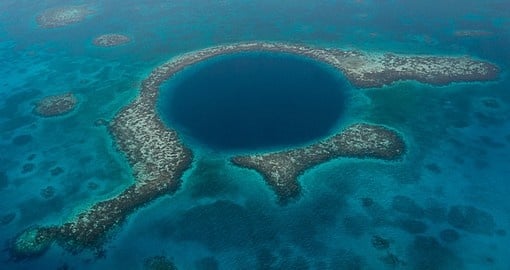
Plummet into the depths of the Blue Hole: the startlingly vivid blue sinkhole measures 300m (1,000ft) across and over 120m (400ft) deep and is considered one of the best dive sites in the world.
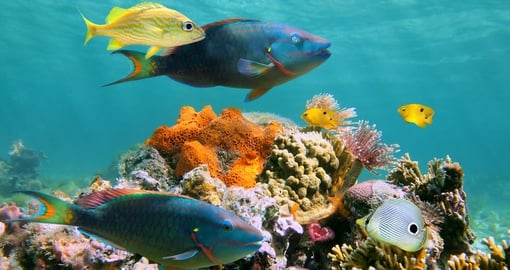
Snorkel in the crystal-clear waters of Hol Chan Marine Reserve: a highlight is swimming with nurse sharks and stingrays in Shark Ray Alley.
Windsurf or sail off the cayes. The water is so clear beneath, it may be possible to spot fish, stingrays and even dolphins. The best wind conditions usually occur from February to June.
Sea kayak at Glover's Reef Atoll: the remote, 260-sq-km (100-sq-mile) lagoon contains beautiful, pristine reefs.
Go bird spotting at Crooked Tree Wildlife Sanctuary: the park is most notable for its jaribu stork population and is also home to howler monkeys, crocodiles, coatimundis, turtles and iguanas.
Join a manatee-watching boat trip: these gentle aquatic mammals are an endangered species, typically growing to about 3m (9.8ft) long.
Cool off in St Herman's Blue Hole National Park: the turquoise waters of the Blue Hole, a 7.6m- (25ft-) deep collapsed sinkhole, are a popular swimming spot. The park is home to an abundance of birds, animals, flora and St Herman's Cave, an ancient Mayan cave.
Go caving: Belize's interior hides thousands of caves. The most accessible is Rio Frio Cave in the Mountain Pine Ridge area. Others which are easy to visit include Che Chem Ha Cave in Cayo district and Blue Creek Cave in Toledo.
Canoe along the Macal River in Cayo district: among the endangered species found here are Morolet's crocodiles, tapirs and jaguars.
Catch fish: Belize's barrier reef is home to grouper, snapper, jack and barracuda, while the deeper waters conceal sailfish, marlin, bonito and pompano. Possible river catches include the enormous jewfish, snook, tarpon and cubera.
Things to See
Gaze at the longest barrier reef in the Western hemisphere: Belize's reef covers 296km (185 miles), including a nearly continuous wall of coral stretching almost 224km (140 miles) from Mexico to the Sapodilla Cayes.
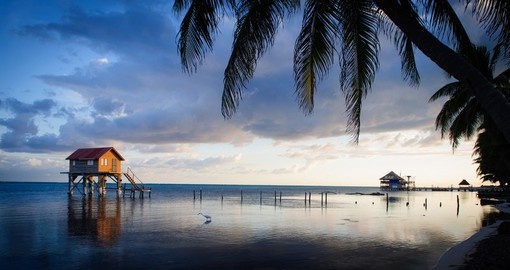
Head offshore to Ambergris Caye's resorts or chill out at a beachside cabaña in laid-back Caye Caulker: the islands make ideal bases for diving and snorkelling.
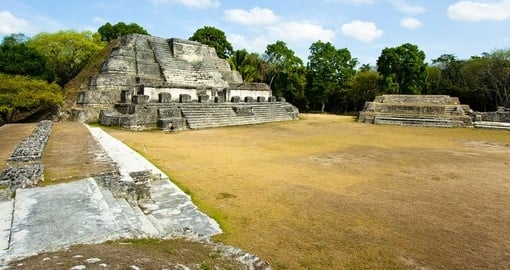
Visit Altun Ha, a major Mayan ceremonial centre and trading centre in the Classic period (AD 250-900); an extraordinary head of the sun god, ornately carved in jade, was found here and is now a national symbol of Belize.
Take a motorboat up the New River from Orange Walk to Lamanai: the spectacular Mayan citadel ruin sits in its own archaeological reserve, which also contains a museum, the remains of two 16th-century Spanish churches and a 19th-century sugar mill.
Discover the famous perfectly carved crystal skull found in a temple vault on the Mayan site of Lubaantum, near the town of San Antonio, in the Toledo District inland from Punta Gorda.
Travel into the Chiquibul rainforest to Caracol: the immense Mayan city in the Cayo district is home to the tallest man-made structure in Belize - Canaa (Sky Palace), rising 43m (140ft) high.
Enjoy fine views and secluded streams in the 121-hectare (300-acre) Mountain Pine Ridge Forest Reserve in the Cayo district. The area contains the Hidden Valley Falls, which plunge 305m (1,000ft) into the valley.
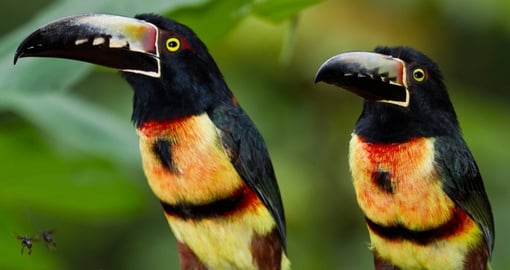
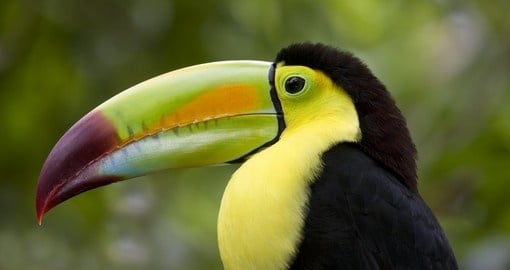
Catch a glimpse of a jaguar in the Cockscomb Basin Wildlife Sanctuary: 40,500 hectares (100,000 acres) of tropical forest were set aside in the Maya Mountains in 1984 to protect the jaguar population. Other residents include jaguarundis, howler monkeys and toucans.
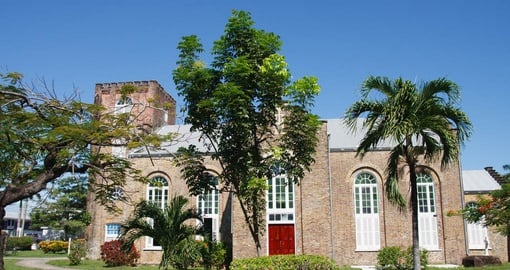
Wander through Belize City: among the sights are St John's Cathedral (the oldest Anglican church in Central America) and Government House, the former residence of the governor-general, built in 1814 and now accommodating the House of Culture Museum (website: http://nichbelize.org).
Travel Advice
The hurricane season in Belize normally runs from June to November.
DETAILS - CANADA |
DETAILS - US |
|---|---|
| All travelers will need a passport valid for at least 90 days following your departure date. However, we strongly recommend traveling with 6 months validity on your passport at all times. Citizens of Canada can refer to www.passport.gc.ca for forms and instructions for new passport applications and Canadian passport renewals. | All travelers will need a passport valid for at least 90 days following your departure date. However, we strongly recommend traveling with 6 months validity on your passport at all times. |
1 city stop over(s) and 5 itineraries are available for Belize
Email: info@goway.com • Accessibility at Goway • Privacy Policy
Booking Conditions Travel Insurance • Careers • Contact Us • Brochures •