
BUCKET LIST
FALKLAND ISLANDS ITINERARIES
- Falklands Wildlife, 8 days
- Wildlife and Battlefields, 8 days
LATIN AMERICAN DESTINATIONS
- Antarctica (12 trips)
- Argentina (28 trips)
- Belize (6 trips)
- Bolivia (10 trips)
- Brazil (28 trips)
- Chile (30 trips)
- Colombia (9 trips)
- Costa Rica (7 trips)
- Ecuador (13 trips)
- El Salvador (4 trips)
- Falkland Islands (2 trips)
- Galapagos (14 trips)
- Guatemala (7 trips)
- Honduras (2 trips)
- Panama (6 trips)
- Peru (36 trips)
- Uruguay (3 trips)
- Venezuela (2 trips)

HOLIDAYS OF A LIFETIME
- Splendours of South America (2012), 17 days
- Splendours of South America (2013), 15 days
- Magical Ecuador and Peru (2012), 20 days
- Magical Ecuador and Peru plus Bolivia (2013/2014), 23 days
- Best of Ecuador, 11 days
- Cradle of the Incas, 13 days
Trekking, walking, wildlife encounters, cycling, rafting, sailing, cruising, camping, safaris, overland journeys and more.
Latin America Brochure
World of Adventure Brochure
GET A FREE TRAVEL QUOTE
Falkland Islands
Country General Information
Whether you are looking for adventure or seeking quieter pleasures, the Falklands are a great place to relax and unwind. From personal encounters of the wildlife kind, to wilderness trout fishing, hiking and self-exploration to guided tours of key cultural and historic sites we invite you to discover all the Falklands has on offer. The Falkland Islands are one of the last untouched wildlife wonders of the World. Unspoiled beaches, islands and cliffs provide a natural safe-haven for hundreds of species that have made the Falklands their home.
Watch albatross soar gracefully through the air against a backdrop of beautiful blue sea and sky, elephant seals sparring on the beach, the tiny Cobb's wren hopping along the shoreline, killer whales circling offshore in pursuit of a meal or sit patiently alongside king penguins and wait for the fluffy chicks to come and take a look at you! The possibilities for enjoying the wildlife experience are endless, as are the photographic opportunities. But there is more to the Islands than wildlife. Join in with the World's most southerly marathon, play a challenging game of golf, hike across hills for panoramic views or fish for sea trout in the estuaries, rivers and streams. Exploring "camp", the name given to anywhere outside the Islands' capital Stanley, is a "must" for any visitor.
If this pace sounds too hectic, simply relax in the comfort of the Islands' hotels, farm houses and lodges. Experience the Falkland way of life on a small island, farm or in Stanley. Discover the history of the Falklands; from the geological perspective of the "stone runs" or through the evidence of human discovery, maritime travel and, of course, the conflict of 1982. Stroll around the shops in Stanley and taste the delights of Falkland food in a restaurant, hotel or public bar.
To design the best itinerary for you, we at Goway would like to know how specific your interests are for;
- Meeting the people
- Hearing about the 1982 Conflict
- Encountering specific wildlife
- Country Facts
- Climate
- Money
- Travel Info
- Passport & Visas
- Islands
- 1982 War
- Fun Facts
- Places of Interest
- Penguins
- Map
Region
South-eastern tip of South America, lying between latitude 51° and 53° S and longitude 57° and 62° W
Area
12,000 square km (4,700 square miles)
Status
The Falkland Islands are an Overseas Territory of the United Kingdom.
Population (2006 Census)
2,478
The Falklands have a British Appointed Governor
Capital
Stanley is the capital city of the Falklands, located on East Falkland around picturesque Stanley Harbour.
Government
The Falkland Islands are an Overseas Territory of the United Kingdom.
Except for defense and foreign affairs, the Falklands are mostly a self-governed territory with an eight member legislative assembly elected every four years. A London appointed governor makes laws "with the advice & consent of the elected legislators."
Geography
The Falkland Islands are located in the South Atlantic Ocean on a projection of the Patagonian continental shelf about 250 nautical miles (288 mi; 463 km) from the Patagonia coastline and slightly to the north of the southerly tip of Cape Horn and of its undersea extension, the Scotia Arc. In ancient geological time this shelf was part of Gondwana, which around 400 million years ago broke from what is now Africa and drifted westwards relative to Africa
Language
English
Time
GMT - 4.
Social Conventions
The Countryside Code has been developed by Falklands Conservation to ensure that the remarkable wildlife and natural environment of the Falklands is protected for the enjoyment of future generations:
Keep to paths wherever possible. Leave gates open and shut, as you find them.
Do not drop litter*, and take your rubbish home with you.
Do not disfigure rocks or buildings.
Never feed wild animals.
Always give animals the right of way. Remember not to block the routes of seabirds and marine mammals coming ashore to their colonies.
Try to prevent any undue disturbance to wild animals. Stay outside bird and marine mammal colonies, and remain at least 6 metres (20 feet) away at all times. When taking photos or filming, stay low to the ground and move slowly and quietly. Do not startle or chase wildlife from resting or breeding areas.
Some plants are protected and should not be picked*, leave wildflowers in the ground for all to enjoy.
Whalebones, skulls, eggs and other such items cannot be exported from the Falkland Islands*. They should be left where they are found.
Electricity
Standard British appliance plugs work in the Falklands, otherwise an adaptor is needed.
Head of State
Queen of England
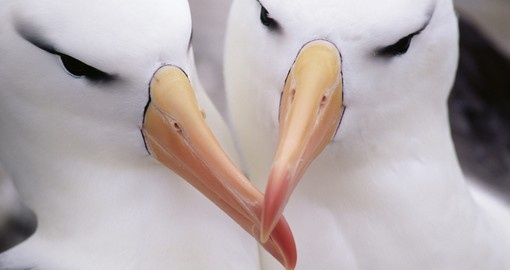
Black-browed Albatross
Recent History
The Falkland Islands have a rich history embracing maritime trade, missionary links, Darwinian discoveries and participation in the two World Wars.
Memorials and reminders of the 1982 conflict feature significantly, but there is much more to discover about the heritage of the Islands. Links with sealers, whalers, explorers and South American indigenous people have helped to shape the culture, as well as the natural environment of today's Falklands.
From fossils to geological features, historic buildings to shipwrecks, reminders of the past can be found everywhere in the Islands.
In a referendum in 2013; Voters overwhelmingly decided to remain a British Territory.
Weather
Hiking through tussock grass
Weather conditions are similar to the United Kingdom, with more hours of sunshine and less rainfall on average. Winters are generally mild with some light snow and summers are slightly cooler than in Britain. Temperatures range from -5°C to 25°C. The islands are relatively sunny in summer, with daily hours of sunshine similar to England's southern coastal regions. It is generally wetter on the east than the west of the islands.
Wind is a fact of life. Be prepared for 4 seasons in a day with layering of clothing.
Currency and Banking Services
Lamb Marking, Bleaker Island
The local currency is the Falklands pound which has the same value as the British pound. British notes and coins are accepted. Many places accept US dollars and Euros. There is one bank, the Standard Chartered Bank in Stanley which is open weekdays. SCB can change money, transfer funds, cash traveller's cheques and issue cash advances against Visa and Mastercard. Usually there are charges for these services for which photo ID is needed. Credit and debit cards can be used in many shops, hotels and restaurants in Stanley; however Diners Club and American Express are not widely accepted. Cash is generally the easiest payment option outside Stanley. There is no ATM / cash machine anywhere in the Falklands.
Travel Info
Malvina House Hotel, Stanley
The best time of year to visit the Falkland Islands is during the Austral Summer, particularly between the months of December to February. This is the peak of wildlife activity and, usually, the warmest time of the year.
Visits outside these times are also rewarding. Elephant seal pubs are at their most adorable in October/November whilst in March/April Magellanic penguins pack some beaches, ready for their long-haul journeys overseas, making a spectacular sight. Winter days are often crisp and clear with bright blue skies - perfect for walking the hills. Important events including the May Ball and Liberation Day are held in winter, offering a glimpse of local culture.
To cater for the differing needs of tourists arriving by air and sea, the Falkland Islands Customs and Immigration Department have developed two separate sets of entry and exit requirements.
Biosecurity
All products of animal origin (e.g. meats, dairy products, eggs, unprocessed feathers, leather, wool and bone), plant and plant material (e.g. fruits, flowers, cuttings, bulbs, barks, seeds) are either restricted or prohibited imports.
Public Holidays
New Year's Day, April 06 Good Friday, April 21 Queen's Birthday, June 14 Liberation Day, October 06 Spring Holiday, December 08 Battle Day, December 25 Christmas
Things to Do
Battlefield sites
Take a trip to some of the battlefield sites associated with the 1982 conflict (including Wireless Ridge, Mount Tumbledown and Sapper Hill). There are also military cemeteries, memorials and museums dealing with the conflict.
Birdwatching
Migratory species, such as penguins, arrive to breed in September and depart late March/early April. Be sure to catch a glimpse of some of these delightful creatures; there are five species on the Falkland Islands.
Fishing
The fishing season runs from September to the end of April, but September to October and mid March to mid April are best for sea trout. Falklands mullet is available throughout the period. The best locations in West Falkland are Warrah and Little Chartres, while in East Falkland, San Carlos and Murrel are good. Port Howard and Hill Cove also allow fishing.
Horse riding
Go horse riding, available in Port Howard. There is also the opportunity to learn about the traditional horse equipment used in the Falkland Islands.
Rockhopper Point, Sea Lion Island
Maritime history trail
Stanley hails back to the days when great sailing ships and early steam vessels called into port on their journeys around Cape Horn. A self-guided Maritime History Trail has been set up in the capital, which takes half a day and leads from Stanley to Cape Pembroke, offering an interesting introduction to the Falkland Islands' birdlife.
Sea Lion Island
Sea Lion is home to some amazing wildlife, including elephant seals, sea lions and king penguins, as well as killer whales offshore. It is the most southerly inhabited island, and all areas are accessible by 4-wheel drive or on foot from the Sea Lion Lodge.
Stanley
The capital has pubs, snack bars and restaurants, as well as a golf course and racecourse. Government House, Stanley Museum and the Cathedral are all worth visiting.
Stanley Harbour Boat Tour
Take a tour around Stanley Harbour in an inflatable craft. A number of lodges have motor boats for taking guests to view wildlife and places of interest. Tours around Kidney Island and Sparrow Cove can be arranged.
Wreck diving. Nineteenth-century sailing ships and iron vessels can be seen at Stanley and Darwin. The views in winter are spectacular due to the 'grey beards' - winter waves that can reach a height of 4.5m (15ft).
Travel Advice
Most visits to the Falkland Islands are trouble-free and there is little crime or disorder.
Travellers should be aware of the global risk of indiscriminate international terrorist attacks, which could be against civilian targets, including places frequented by foreigners.
Falkland Islands Government regulations state that you obtain comprehensive travel and medical insurance before travelling.
This advice is based on information provided by the Foreign and Commonwealth Office in the UK. It is correct at time of publishing. As the situation can change rapidly, visitors are advised to contact the following organisations for the latest travel advice:
British Foreign and Commonwealth Office
Tel: 0845 850 2829.
Website:www.fco.gov.uk
US Department of State
Website:http://travel.state.gov/travel
Visas
Entry to the Falkland Islands is controlled by the Customs and Immigration Department located in Stanley, Falkland Islands. Falkland Islands tourist visa is not required for citizens of United States or Canada for a stay up to 30 days. As things can change please contact the local embassy for the latest information prior to your travel.
Put a Penguin in your passport
East Falkland
Port Howard, West Falklands
East Falkland is the largest of all the Islands in the archipelago, home to more than 85% of the country's population and the tallest mountain in the Islands (Mount Usborne, 705m).
Part of the appeal of the Falklands is the change in the natural environment and wildlife between locations. The destinations detailed here are merely a starting point for planning your own Falklands' adventure and should not be regarded as an exhaustive list of all you can see and do.
Some places make excellent day trips from Stanley, whilst a number of destinations offer accommodation and are well worth exploring for a longer period of time. Most points of interest are accesible by road, and for those on tight timelines a short flight is also available to selected locations with the Falkland Islands Government Air Service (FIGAS). Some additional day-trips are offered exclusively to cruise ship passengers as special tours - details can be found in the cruise ship excursions section.
Once you're ready to set out, be sure to read the Countryside Code to make sure you get the best of your experience. Always check with the landowner first for permission to access land - in a few cases there is a small fee for this. Visitors making an overnight stay at a destination can usually do this via their accommodation provider.
West Falkland
Public Bench on Waterfront, Stanley
"West is best" is the common catchphrase used by those lucky enough to live on the Falklands' second largest island. Accessing the West has never been easier - with flight and ferry access available from neighbouring East Falkland - providing direct access to some of the most spectacular scenery in the Islands.
Once you're ready to set out, be sure to read the Countryside Code to make sure you get the best of your experience. Always check with the landowner first for permission to access land - in a few cases there may be a small fee for this. Visitors making an overnight stay at a destination can usually do this via their accommodation provider.
Outer Islands
Undoubtedly the highlight for many visitors is the handful of outer islands scattered around the edges of East and West Falkland, accessible by plane and in some cases by cruise ship and boat. Each island offers something different to its neighbour, both in terms of flora and fauna and natural beauty.
The following descriptions refer to islands that offer accommodation for tourists and are accessible by the Falkland Island Government Air Service FIGAS. Details of destinations available to some cruise ship passengers can be found on the Cruise Ship Landings page.
Once you're ready to set out, be sure to read the Countryside Code to make sure you get the best of your experience. Land owners are generally accommodation providers on these islands so by arranging a visit with them, permission to roam is already given.
Stanley
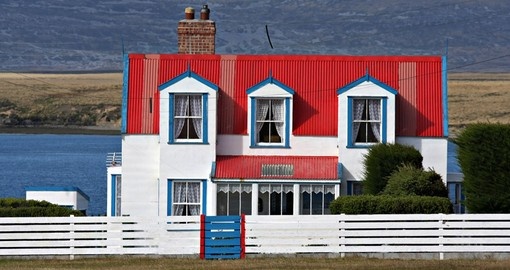
Stanley, the capital of the Falklands, is a colourful seaside town nestled around the waters of Stanley Harbour. The town boasts many reminders of its British heritage, such as red phone boxes and six distinctly English pubs. Visitors can enjoy the many military monuments, Museum, Philatelic Bureau - and of course retail outlets and restaurants.

A Short History of the 1982 Falklands War
Between Great Britain and Argentina
- Argentina, even today, lays claim to "las Malvinas"
- 1982 President Galtieri, the head of Argentina's ruling militaty junta, authorized an invasion of the Malvinas to draw attention away from human rights and economic issues at home
- April 2, Argentina forces landed in the Falklands capturing the islands 2 days later
- After diplomatic effors failed, UK's Prime Minister, Margaret Thatcher, ordered a naval task force to retake the Islands
- As Port Stanley's airstrip was too short for modern fighters the Argentine Air Force was forced to fly from the mainland, a big disadvantage during the conflict
- On May 1st the Argentinean light cruiser General Belgrano was sunk by a British submarine killing 323. The attack led to the Argentinean fleet remaining in port for the rest of the war
- An SAS raid on Pebble Island preceeded the landing of 4000 British Forces at San Carlos Water. Shopes supporting the landing were sunk by Argentine aircraft
- On May 27, 1982 a battle at Darwin and Goose Green led to an Argentine defeat, as did another battle on Mt. Kent a couple days later
- In early June, 5000 British troops arrived. While landing at Bluff Cove and Fitzroy, their transports were attacked and 56 died
- On the night of June 11, British troops launched simultaneous attacks on the high ground surrounding Stanley. Wireless Ridge and Mount Tumbledown were the last natural lines of defense to fall
- Encircled on land and blockaded at sea, the Argentinean commander General Mario Menendez surrendered his 9,800 men on June 14
- During the war, Britain suffered 258 killed and 777 wounded. In addition, 2 destroyers, 2 frigates and 2 auxiliary vessels were sunk. For Argentina, the Falklands War cost 649 killed, 1,068 wounded and 11,313 captured. In addition the Argentine Navy lost a submarine, a light cruiser and 75 fixed-wing aircraft
- Four days after the Fall of Stanley, Argentina's President Galtieri was removed from office spelling the end of the ruling military junta and paving the way for the restoration of democracy
- For Britain, the victory provided a boost to National Confidence, reaffirming their international pposition and assuring a victory for the Thatcher government in the 1983 election
- Despite the defeat, Argentina still claims the Falkland Islands and South Georgia, as "las Malvinas"
Memorial to the 1982 Falklands War
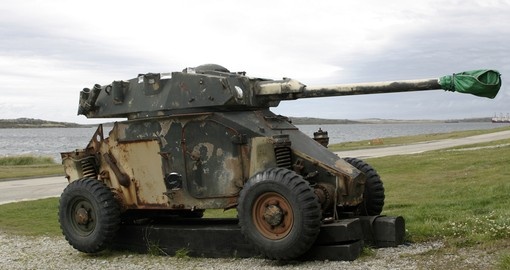
Old Rusty Tank from the War of 1982
Coming in to Land on Sea Lion Island
Falkland Islands Fun Facts and Tips
Photo with the Locals
- The Falklands are a compact group of 740 islands with a total land area approximately the size of Connecticut. They are as close to the South Pole as London is to the North Pole.
- Their economy depends on fishing license fees, tourism and agriculture (over 160 sheep per person).
- The 2006 census showed a population of 2478; 2115 of which lived in Stanley. 54% were born in the Islands. Many North American high schools have more people.
- They are an independent overseas territory of the United Kingdom, financially independent of everything except defense services (provided by Britain). They even have their own currency.
- There is a British military force of 1300 troops on the islands, equipped with a variety of aircraft, surface-to-air missiles and other weaponry.
- The Islanders seem to be more British than the British and come across as a British country community of 50 years ago.
- In a Referendum in 2013, 99.8% of voters decided they wanted to remain a British overseas territory.
- The Falklands are accessed by flights by LAN from Santiago (Chile) via Punta Arenas once a week and by British Defense flights from England twice a week.
- The Falklands international airport (Mount Pleasant) is actually a military airport. Arrivals and Departures areas are designed for the military.
- Falkland Islands Government Air Service (FIGAS) operate Britten Norman Islander aircraft to air strips around the islands to locations of accommodation providers. Stanley Airport is 10 minutes from the town centre.
- Many places are only accessible by air or 4WD (usually landrovers).
- The local term for everything outside Stanley is "camp" derived from "campo", the Spanish word meaning countryside.
- Wind is a fact of life. Be prepared for 4 seasons in a day, and layering of clothing.
- The Falklands are home to more than 220 species of identified bird. As well there are whales, dolphins, elephant seals, sea lions, delicate flora and rugged geographical formations.
- There are 5 species of penguin. The King, The Gentoo (world's largest population at 30% of total), The Rockhopper, The Macaroni and The Magellanic penguin.
- Volunteer Point is home to the largest King penguin colony in the Falkland Islands and is the most accessible in the world (which is by 4WD).
- In total:
- There are over 500,000 breeding pairs of penguins.
- It is said that most of the pictures of penguins you will see were photographed in the Falklands.
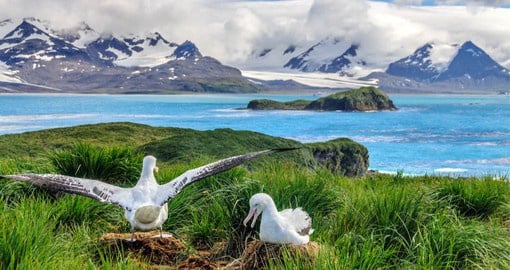
- Approximately 65% of the world's black-browed albatrosses live in the Falklands.
- They are the only place to see the Falklands steamer duck and Cobbs wren.
- A visit to one of the few local pubs is a must and you are guaranteed to meet some characters.
- Many people have a "day job" and a government job (e.g. customs at the airport on Saturday).
- The weekly newspaper is called "The Penguin News"
- Suggested movies are "An Ungentlemanly Act" a 1992 BBC TV film about the first days of the invasion, "Shackleton" a 2002 British TV film and "March of the Penguins".
Peat Cutting, Long Island
Places of Interest
Stanley, a bit of England in the South Atlantic
The Falkland Islands are a unique and different destination of appeal to serious globetrotters. If you are a birder or photographer you will find paradise. If you like history and politics you will love the story of the Falklands. You will also enjoy meeting the friendly people that run what is probably the most remote small country in the world.
Below are some of the places you will find of interest. Many places even near Stanley are only accessible by 4WD vehicles. Outside Stanley, which the locals call "camp", you will most likely have to fly to by small aircraft.
When planning a visit to the Falklands make sure you advise us if you are looking for a wildlife experience (and what animals), a battlefields experience or a combination of both. Please also advise if you have any other special interests so that we can plan an enjoyable and unforgettable visit.
Stanley
Capital of the Falkland Islands, and with a population of around 2,000 it is one of the smallest and most remote capital cities in the world. Set on a natural harbour, the colourful seaside town has a rich maritime history from the days when great sailing ships and early steam vessels called in on their journeys around Cape Horn. Some of those ships still lie in the harbour, abandoned after a Cape Horn battering.
Some of the places you are likely to see are:
- The Lady Elizabeth shipwreck
- The Totem Pole
- Memorial Wood (Note, there are not many trees in the Falklands. Fuel in the early days came from peat which was very plentiful)
- Stanley Cemetery
- Jubilee Villas (British terraced town houses - built in 1887)
- Christ Church Cathedral (Southern most Anglican cathedral in the world, visitors are welcomed)
- Whalebone arch (jawbones from two blue whales)
- Cartmell Cottage (brought in kit from Britain in 1849)
- Colonists Cottage
- 1982 Liberation Monument
- Government House (home and office of the Governor)
- Battle Memorial (commemorating the battle between British and German fleets in 1941)
- Falkland Islands museum
There are also a couple of interesting local pubs that are worth a visit. Please note they close early.
Wreck of the Lady Elizabeth
Bertha's Beach (East Falklands)
Located close to the Mount Pleasant Complex, this beautiful white sand beach is a popular destination for a day trip. Gentoo penguins and a variety of other flora and fauna provide perfect photography opportunities.
Darwin (East Falklands)
A small settlement with great historical value, Darwin has a magnificent stone corral and many points of interest associated with the 1982 Conflict. The Argentine cemetery is situated 10 minutes drive away.
Fitzroy (East Falklands)
Memorials to the Welsh Guard and the Royal Fleet Auxiliary who served on board the Sir Galahad and Sir Tristram bombed off the coast of Fitzroy in 1982.
Goose Green (East Falklands)
Situated close to Darwin, Goose Green is long established as a sheep farm with the largest shearing shed in the Islands. Made famous in the 1982 Conflict, 114 Falkland Islanders were held captive in the Community Hall. Bodie Creek Bridge, the World's most southerly suspension bridge, is a short drive away.
San Carlos (East Falklands)
San Carlos was the site of the British landing in 1982. Today the British cemetery overlooks Bomb Alley, the areas in which a number of British ships were bombarded. A small museum houses relics from the conflict and other items of historical interest. Ajax Bay, the area used as a field hospital in 1982 is situated nearby.
Volunteer Point (East Falklands)
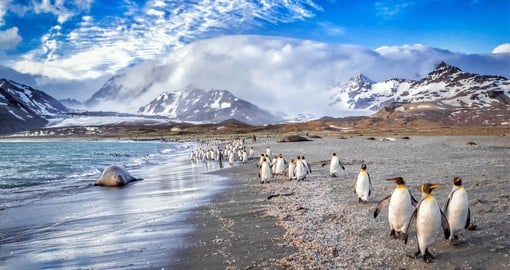
One of the most popular destinations for day-trippers, Volunteer Point is home to the largest king penguin colony in the Falkland Islands, and the most accessible in the World. Magellanic and gentoo penguins nest in large numbers nearby along with numerous smaller birds.
Port Howard (West Falklands)
Port Howard is an attractive sheep farming settlement situated on the east coast and is easy to explore on foot. A nine hole, par three golf course overlooking the settlement and harbour, is owned and occasionally maintained by a local landowner and may be played by visitors on request. Fishing enthusiasts will find Port Howard an excellent destination to use as a base for sea trout fishing on the Warrah and Chartres rivers.
Bleaker Island
Bleaker Island is home to three species of penguin, a large imperial cormorant colony, southern giant petrels, many smaller birds and a variety of waterfowl on the ponds. The rare flying steamer duck can sometimes be spotted and marine mammals are often observed offshore.
The settlement is situated in the middle of the island and still operates a sheep farm. Plenty of walking opportunities are available around the island including long sandy beaches with beautiful views.
Carcass Island
Cat and rat free it is a haven for small bird species including the endemic Cobb's wren, dark faced ground tyrants and tussac birds. Striated cara-caras are prevalent and short-eared owls breed in the island's forest. Marine mammals and penguins also inhabit the island.
The scenery is varied with beautiful white sandy beaches, tussac paddocks, rock hills and clifftops; this is a fantastic destination for both walking enthusiasts and those who prefer just a short stroll or drive to a scenic post. West Point Island can also be reached from Carcass Island by boat.
Governor's Residence - Stanley
Pebble Island
Pebble Island is named after the unusual, translucent semi-precious stones found on its beaches. It has a distinctive mountain range and is home to more than 40 wildlife species including gentaoo, rockhopper, macaroni and magellanic penguins, imperial cormorant, waterfowl and black-necked swans. The eastern end of the island has wetlands and large ponds with many waterfowl and wading birds. This island is also noted for events of the 1982 conflict.
Sea Lion Island
Five miles long and just over a mile wide at its widest point, it is just the right size to spend a day, or more, exploring. Beautiful tussac plantations cover one fifth of the island and provide a perfect habitat and protection for much of the island's varied fauna, including elephant seals and sea lions. Sand beaches, cliffs, freshwater ponds and heathland provide a diversity of habitats, all with their own wildlife. The 47 different species of breeding birds to be viewed on the island include three species of breeding penguins and five different birds of prey. Every year brings exciting sightings of vagrants. Pods of killer whales circle the island in pursuit of the elephant seals and sea lions that breed there. Leopard seals and larger whales are also seen from time to time. A memorial to the HMS Sheffield, sunk in nearby waters, is situated on the island.
Please note that accommodation at most locations is very limited and early booking is required. We also have to co-ordinate transport between locations.

Penguins of the Falklands Islands
Of the 220 species of bird in the Falkland Islands, five of them are penguins. The King, The Gentoo (world's largest population, 30%), The Rockhopper, The Macaroni and the Magellanic. One location of King penguins is the most accessible in the world (which is by 4WD). In total there are over 500,000 breeding pairs of penguins. It is said that most of the pictures of penguins you see were probably photographed in the Falkland Islands.
Penguin length is measured from the tip of the bill to the tip of the tail, in an outstretched bird. This is a more reliable measurement than height, since it is not affected by variations in stance.
Although it is not hard to enjoy penguin encounters, colonies do vary in size. Please let the Travel Experts at Goway know if there is a particular penguin you really want to meet and we will recommend appropriate locations in your itinerary.
Magellanic Penguins
Magellanic penguins are only found around the Falkland Islands and South America, but they are extremely numerous within these regions. The Falklands has a population well in excess of 100,000 breeding pairs.
The Magellanic penguin is around 70cm long, and has an average weight of about 4kg. The head and upper parts are black apart from two broad white stripes beneath the throat; one running up behind the cheeks and above the eye to join the pinkish gape, the second running adjacent to the white underparts with which they merge above the legs. Females are slightly smaller than the males, but have similar plumage.
Magellanic penguins prefer to nest in burrows, but when soil conditions are unsuitable for burrowing, they will nest on the surface using whatever protection they can find.
Magellanic penguins from both the Falkland Islands and South America face natural predators at sea, such as sea lions, leopard seals and orcas (killer whales). They also face predation of chicks and eggs by avian predators, such as gulls and skuas, but where the penguins nest in burrows, such predation is greatly reduced.
Magellanic penguins are popular for tourism, but they are the most nervous of penguins. Visitors that approach breeding sites which do not normally have many visitors, will send the penguins scurrying into their burrows for safety. Magellanic penguins do readily adapt to regular visitation however, and become much less nervous with time.
They are often referred to locally as jackass penguins because of their mournful braying call, a typical sound of the Falkland summer which continues through much of the night.
Rockhopper Penguin
Rockhopper penguins are amongst the smallest of the world's penguins, having an average length of around 52cm, and an average weight of about 3kg. A yellow stripe above each eye projects into a yellow crest, and these are joined behind the head by a black occipital crest. The eyes are red, the short bulbous bill is reddish brown, and the feet and legs are pink. The females are slightly smaller than the males but have a similar plumage.
Colonies are often shared with nesting albatross or cormorants. Rockhopper penguins not only return to the same breeding site each year, but they also utilize the same nest, which they refurbish with stones, sticks, vegetation or any other suitable material. Their preferred nesting sites are steep rock gullies, above approaches into deep water.
Despite being amongst the smallest of penguins, Rockhopper penguins are perhaps the most aggressive. They show little fear of people or of birds and animals larger than themselves. Anything that comes within range of an incubating bird will be pecked, including another Rockhopper, or the long wings of neighbouring albatross. Nevertheless, Rockhopper penguins can be very gentle with their partners, and allopreening (mutual preening) is common.
Rockhammer penguins love jumping over rocks to get about rather than sliding on their bellies like normal penguins. The colorful feathers on their heads make it hard to mistake them, and the crazy colors that are on all feathers going in all directions, remind people of the punk rock generation.
Macaroni Penguin
The Macaroni penguin is the most numerous of all the world's penguins, with an estimated world population of over 9 million breeding pairs. They are substantially larger than Rockhoppers, having an average length of around 70cm and an average weight of 5.5kg. The head and upperparts are bluish black, and the underparts are white. Their large reddish brown bill has exposed pink skin at its base; the eyes are red and the legs and feet are pink. The most distinctive features are the golden yellow crests which extend from the centre of the forehead and sweep backwards above the eyes. Females are smaller than the males, but have similar plumage. Juveniles lack the elegant crests, and have dull brown eyes, and browny black bills.
Macaroni penguins breed in colonies on rocky coasts and low cliffs. Their natural predators, such as sea lions and orcas (killer whales) occasionally take adults at sea, whilst gulls, skuas and birds of prey patrol breeding sites for eggs and young. With current populations being so high, there are no special concerns for this species.
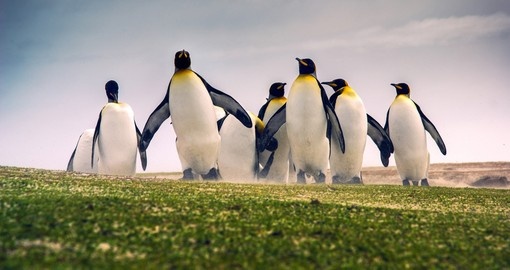
King Penguin
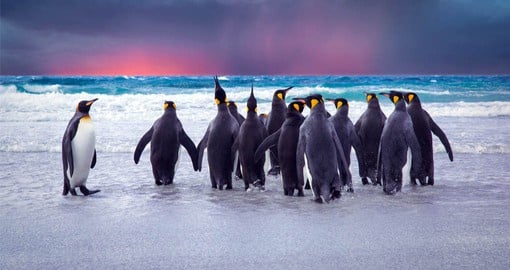
King penguins no longer breed in Patagonia, or indeed any other part of South America. The King penguin is the world's second largest penguin, with a typical weight of 12-14kg, and an average length of 90cm.
King penguins have distinctive orange patches on either side of the head, which extend down and meet beneath the chin, where they become yellow and fade into the silvery white breast plumage. The mandibular plates on either side of the bill are also orange in color. The female is slightly smaller than the male, but has similar plumage.
King penguins make no nest, and instead lay a single egg of around 310g, which they hold on their feet for the entire incubation period of about 55 days. This adaption allows breeding in much colder terrain than would be the case for species that lay their eggs on the ground, and negates the need for nesting material. The eggs are brooded by both parents in turn, with shift changes of 6-18 days; the non-brooding parent going to sea on extended foraging trips.
The newly hatched chicks are also held on the parents' feet for the first 30-40 days, by which time they have developed their mesoptile plumage, and are able to regulate their own body heat.
Human impact is currently very low, despite King penguins being a great tourist attraction in the Falklands. They are very tolerant of human presence, and are not alarmed by the presence of tourists, provided that they remain at the outskirts of the colony.
Gentoo Penguin
Gentoo penguins have an average length of 80cm and an average weight of 5kg. They have a reddish orange bill, apart from the black culminicorn, and orange feet. White patches about each eye meet across the crown, with white speckling in the adjacent black plumage around the head. Females are slightly smaller than the males, but have similar markings.
Gentoo penguins are ground nesting birds, making rudimentary nests from stones, sticks, grass, feathers, or practically any material that they can find suitable for the purpose.
Because Gentoo penguins at most sites tend to move the colony a few meters each year, they do not retain the same nests from year to year. On occasions whole colonies that have remained at one site for years, will up and move to a new site many kilometers away, for no apparent reason. This may happen suddenly during a single year, or gradually over a number of years.
By comparison with other penguins, Gentoo pair-bonds are often long-lasting, despite annual nest changes. Many adults remain around the colony throughout the year, whilst others take the opportunity during the winter months to make longer foraging trips further afield.
The Falklands is the only Gentoo penguin breeding site with human habitation. Although farming has greatly modified the landscape around the Falklands, Gentoo penguins prefer open plains to breed, and consequently have not been greatly affected by the loss of tall tussac grass. Gentoo penguins are also very tolerant of grazing animals, such as sheep, cattle and horses, which often wander around Gentoo colonies without causing alarm.
For many years the rural communities of the Falkland Islands took Gentoo eggs for food. Until recent years these eggs were an important supplement to the diet of many folk, but now with regular supplies of hen eggs the tradition is gradually dying out. Penguin eggs are always taken at the start of incubation, and the birds rapidly re-lay, so that colonies which have had eggs taken show little difference in productivity by the time chicks are ready to fledge.
2 itineraries are available for Falkland Islands
Email: info@goway.com • Accessibility at Goway • Privacy Policy
Booking Conditions Travel Insurance • Careers • Contact Us • Brochures •