
BUCKET LIST
PANAMA ITINERARIES
- Bocas del Toro, 3 days
- Canal & Rainforest Experience, 7 days
- Historic Panama, 3 days
- Journey Between the Seas, 8 days
- Panama - The Path Less Travelled, 7 days
- Panama Canal Partial Transit, 3 days
LATIN AMERICAN DESTINATIONS
- Antarctica (12 trips)
- Argentina (28 trips)
- Belize (6 trips)
- Bolivia (10 trips)
- Brazil (28 trips)
- Chile (30 trips)
- Colombia (9 trips)
- Costa Rica (7 trips)
- Ecuador (14 trips)
- El Salvador (4 trips)
- Falkland Islands (2 trips)
- Galapagos (14 trips)
- Guatemala (7 trips)
- Honduras (2 trips)
- Panama (6 trips)
- Peru (36 trips)
- Uruguay (3 trips)
- Venezuela (2 trips)

HOLIDAYS OF A LIFETIME
- Splendours of South America (2012), 17 days
- Splendours of South America (2013), 15 days
- Magical Ecuador and Peru (2012), 20 days
- Magical Ecuador and Peru plus Bolivia (2013/2014), 23 days
- Best of Ecuador, 11 days
- Cradle of the Incas, 13 days
Trekking, walking, wildlife encounters, cycling, rafting, sailing, cruising, camping, safaris, overland journeys and more.
Latin America Brochure
World of Adventure Brochure
Panama
Country General Information
Panama is the southernmost country of Central America. A transcontinental country, its isthmus constitutes the southernmost part of a natural land bridge between the continents of North America and South America.
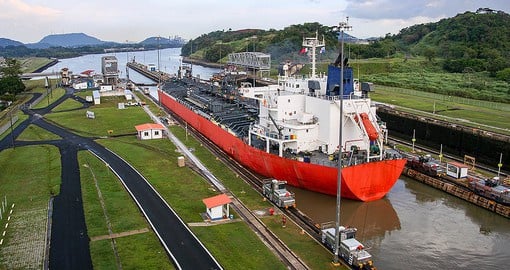
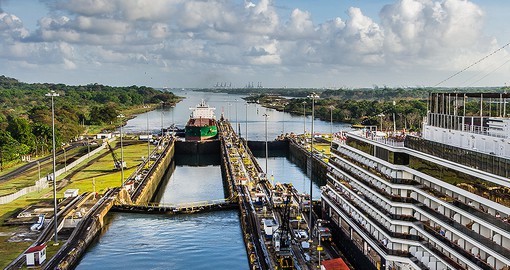
By 1999, Panama controlled the Panama Canal that links the North Atlantic Ocean via the Caribbean Sea with the North Pacific Ocean. It borders Costa Rica to the west, Colombia to the east, the Atlantic Ocean to the north and the Pacific Ocean to the south.
The country is also the smallest in Spanish-speaking Latin America in terms of population, with Uruguay as the second smallest (by almost 400,000). A nearly impenetrable jungle forms the Darien Gap between Panama and Colombia. It creates a break in the Pan-American Highway, which otherwise forms a complete road from Alaska to Chile.
- Country Facts
- Climate
- Money
- Travel Info
- Passport & Visas
Region
South Central America
Area
75,420 sq km
Population
3,460,462 (July 2011 est.)
Population density
22 per km².
Capital
Panama City
Government
Constitutional Democracy
Geography
Panama is located on the narrowest and lowest part of the Isthmus of Panama that links North America and South America. This S-shaped part of the isthmus is situated between 7° and 10° north latitude and 77° and 83° west longitude. Slightly smaller than South Carolina, Panama encompasses approximately 77,082 square kilometers, is 772 kilometers in length, and is between 60 and 177 kilometers in width.
Panama's two coastlines are referred to as the Caribbean (or Atlantic) and Pacific, rather than the north and south coasts. To the east is Colombia and to the west Costa Rica. Because of the location and contour of the country, directions expressed in terms of the compass are often surprising. For example, a transit of the Panama Canal from the Pacific to the Caribbean involves travel not to the east but to the northwest, and in Panama City the sunrise is to the east over the Pacific.
The country is divided into nine provinces, plus the Comarca de San Blas, which for statistical purposes is treated as part of Colón Province in most official documents. The provincial borders have not changed since they were determined at independence in 1903. The provinces are divided into districts, which in turn are subdivided into sections called corregimientos. Configurations of the corregimientos are changed periodically to accommodate population changes as revealed in the census reports.
The country's two international boundaries, with Colombia and Costa Rica, have been clearly demarcated, and in the late 1980s there were no outstanding disputes. The country claims the seabed of the continental shelf, which has been defined by Panama to extend to the 500-meter submarine contour. In addition, a 1958 law asserts jurisdiction over 12 nautical miles from the coastlines, and in 1968 the government announced a claim to a 200-nautical-mile Exclusive Economic Zone.
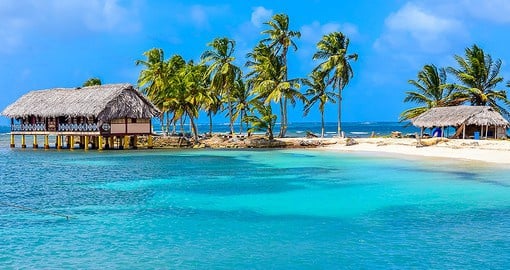
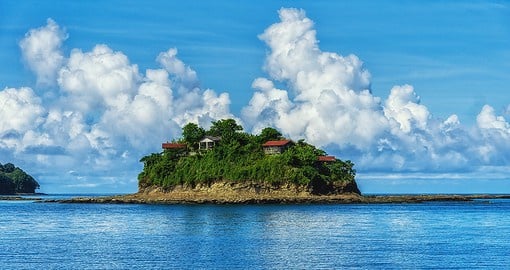
The Caribbean coastline is marked by several good natural harbors. However, Cristóbal, at the Caribbean terminus of the canal, had the only important port facilities in the late 1980s. The numerous islands of the Archipiélago de Bocas del Toro, near the Costa Rican border, provide an extensive natural roadstead and shield the banana port of Almirante. The over 350 San Blas Islands, near Colombia, are strung out for more than 160 kilometers along the sheltered Caribbean coastline.
The major port on the Pacific coastline is Balboa. The principal islands are those of the Archipiélago de las Perlas in the middle of the Gulf of Panama, the penal colony on the Isla de Coiba in the Golfo de Chiriquí, and the decorative island of Taboga, a tourist attraction that can be seen from Panama City. In all, there are some 1,000 islands off the Pacific coast.
The Pacific coastal waters are extraordinarily shallow. Depths of 180 meters are reached only outside the perimeters of both the Gulf of Panama and the Golfo de Chiriquí, and wide mud flats extend up to 70 kilometers seaward from the coastlines. As a consequence, the tidal range is extreme. A variation of about 70 centimeters between high and low water on the Caribbean coast contrasts sharply with over 700 centimeters on the Pacific coast, and some 130 kilometers up the Río Tuira the range is still over 500 centimeters.
The dominant feature of the country's landform is the central spine of mountains and hills that forms the continental divide. The divide does not form part of the great mountain chains of North America, and only near the Colombian border are there highlands related to the Andean system of South America. The spine that forms the divide is the highly eroded arch of an uplift from the sea bottom, in which peaks were formed by volcanic intrusions.
Language
Spanish is the official language. English is spoken in major tourist areas.
Religion
81% Roman Catholic, 2.1% other denominations, 16.3% unspecified or none.
Time
GMT - 5.
Electricity
220 volts AC, 60Hz. (110 volts AC is available in most 4- and 5-star hotels.)
Head of State
President
History
(With thanks to Lonely Planet)
The coastlines and rainforests of Panama have been inhabited by humans for at least 10,000 years, and it’s estimated that several dozen indigenous groups including the Kuna, the Ngöbe-Buglé, the Emberá, the Wounaan and the Naso were living on the isthmus prior to the Spanish arrival. However, the historical tragedy of Panama is that despite its rich cultural history, there are virtually no physical remains of these great civilizations.
Unlike the massive pyramid complexes found throughout Latin America, the ancient towns and cities of Panama vanished in the jungles, never to be seen by the eyes of the modern world. However, tales of lost cities still survive in the oral histories of Panama’s indigenous communities, and there is hope amongst Panamanian archaeologists that a great discovery lies in waiting. Considering that much of Panama consists of inaccessible mountains and rainforests, perhaps these dreams aren’t so fanciful.
What is known about pre-Columbian Panama is that early inhabitants were part of an extensive trading zone that extended as far south as Peru and as far north as Mexico. Archaeologists have uncovered exquisite gold ornaments and unusual life-size stone statues of human figures as well as distinctive types of pottery and metates (stone platforms that were used for grinding corn).
Panama’s first peoples also lived beside both oceans, and fished in mangrove swamps, estuaries and coral reefs. Given the tremendous impact that fishing has had on the lives of Isthmians, it seems only fitting that the country’s name is derived from an indigenous word meaning ‘abundance of fish.’
New World Order
In 1501 the discovery of Panama by Spanish explorer Rodrigo de Bastidas marked the beginning of the age of conquest and colonization in the isthmus. However, it was his first mate, Vasco Núñez de Balboa, who was to be immortalized in the history books, following his discovery of the Pacific Ocean 12 years later.
On his fourth and final voyage to the New World in 1502, Christopher Columbus went ashore in present-day Costa Rica and returned from the encounter claiming to have seen ‘more gold in two days than in four years in Spain.’ Although his attempts to establish a colony at the mouth of the Río Belén failed due to fierce local resistance, Columbus petitioned the Spanish Crown to have himself appointed as governor of Veraguas, the stretch of shoreline from Honduras to Panama.
Following Columbus’ death in 1506, King Ferdinand appointed Diego de Nicuesa to settle the newly claimed land. In 1510 Nicuesa followed Columbus’s lead, and once again tried to establish a Spanish colony at Río Belén. However, local resistance was once again enough to beat back Spanish occupation, and Nicuesa was forced to flee the area. Leading a small fleet with 280 starving men aboard, the weary explorer looked upon a protected bay 23km east of present-day Portobelo and exclaimed: ‘¡Paremos aquí, en nombre de Dios!’ (‘Let us stop here, in the name of God!’). Thus was named the town of Nombre de Dios, one of the first Spanish settlements in the continental New World.
Much to the disappointment of Columbus’ conquistador heirs, Panama was not abundant with gold. Add tropical diseases, inhospitable terrain and less than welcoming natives to the mix, and it’s easy to see why Nombre de Dios failed several times during its early years as a Spanish colony. However, a bright moment in Spanish exploration came in 1513 when Balboa heard rumors about a large sea and a wealthy, gold-producing civilization across the mountains of the isthmus – almost certainly referring to the Inca empire of Peru. Driven by equal parts ambition and greed, Balboa scaled the Continental Divide, and on September 26, 1513, he became the first European to set eyes upon the Pacific Ocean. Keeping up with the European fashion of the day, Balboa immediately proceeded to claim the ocean and all the lands it touched for the king of Spain.
The Empire expands
In 1519 a cruel and vindictive Spaniard named Pedro Arias de Ávila (or Pedrarias, as many of his contemporaries called him) founded the city of Panamá on the Pacific side, near where Panama City stands today. The governor is best remembered for such benevolent acts as ordering the beheading of Balboa in 1517 on a trumped-up charge of treason as well as ordering murderous attacks against the indigenous population, whom he roasted alive or fed to dogs when the opportunity permitted.
Despite his less than admirable humanitarian record, Pedrarias established Panamá as an important Spanish settlement, a commercial center and a base for further explorations, including the conquest of Peru. From Panamá, vast riches including Peruvian gold and Oriental spices were transported across the isthmus by foot to the town of Venta de Cruces, and then by boat to Nombre de Dios via the Río Chagres. Vestiges of this famous trade route, which was known as the Sendero Las Cruces (Las Cruces Trail), can still be found today throughout Panama.
As the Spaniards grew fat and content on the wealth of plundered civilizations, the world began to notice the prospering colony, especially the English privateers lurking in coastal waters. In 1572 Sir Francis Drake destroyed Nombre de Dios, and set sail for England with a galleon laden with Spanish gold. It was also during this expedition that Drake climbed a high tree in the mountains, thus becoming the first Englishman to ever set eyes on the Pacific Ocean.
Hoping to stave off further ransacking and pillaging, the Spanish built large stone fortresses at Portobelo and Fuerte San Lorenzo. However, these fortifications weren’t enough to stop the Welsh buccaneer Sir Henry Morgan from overpowering Fuerte San Lorenzo and sailing up the Río Chagres in 1671. After crossing the length of the isthmus, Captain Morgan destroyed the city of Panamá, made off with its entire treasure and arrived back on the Caribbean coast with 200 mules loaded with loot.
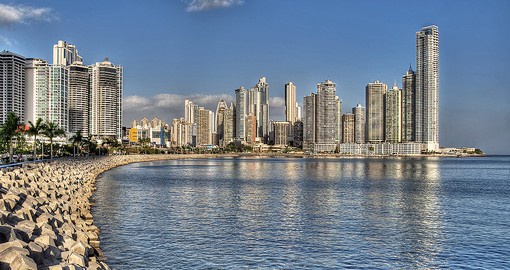
After Panamá burnt to the ground, the Spanish rebuilt the city a few years later on a cape several kilometers west of its original site. The ruins of the old settlement, now known as Panamá Viejo, as well as the colonial city of Casco Viejo, are both located within the city limits of present-day Panama City.
Of course, British privateering didn’t cease with the destruction of Panamá. In 1739 the final nail in the coffin was hammered in when Admiral Edward Vernon destroyed the fortress of Portobelo. Humiliated by their defeat and robbed of one of their greatest defenses, the Spanish abandoned the Panamanian crossing in favor of sailing the long way around Cape Horn to the western coast of South America.
The Empire ends
On October 27, 1807, the Treaty of Fontainebleau, which defined the occupation of Portugal, was signed between Spain and France. Under the guise of reinforcing the Franco-Spanish army occupying Portugal, Napoleon moved tens of thousands of troops into Spain. In an act of military genius, Napoleon ordered his troops to abandon the ruse and seize key Spanish fortifications. Without firing a single shot, Napoleon’s troops seized Barcelona after convincing the city to open its gates for a convoy of wounded soldiers.
Although Napoleon’s invasion by stealth was successful, the resulting Peninsular War was a horrific campaign of guerrilla warfare that crippled both countries. As a result of the conflict, its subsequent power vacuum and decades of internal turmoil, Spain lost nearly all of its colonial possessions in the first third of the century.
Panama gained independence from Spanish rule in 1821, and immediately joined Gran Colombia, a confederation of Colombia, Bolivia, Ecuador, Peru and Venezuela, a united Latin American nation that had long been the dream of Simón Bolívar. However, internal disputes lead to the formal abolishment of Gran Colombia in 1831, though fledgling Panama retained its status as a province of Colombia.
Birth of a nation
Panama’s future forever changed from the moment that the world’s major powers learned that the isthmus of Panama was the narrowest point between the Atlantic and Pacific Oceans. In 1846 Colombia signed a treaty permitting the US to construct a railway across the isthmus, though it also granted them free transit and the right to protect the railway with military force. At the height of the California gold rush in 1849, tens of thousands of people traveled from the east coast of the US to the west coast via Panama in order to avoid hostile Native Americans living in the central states. Colombia and Panama grew wealthy from the railway, and the first talks of an interoceanic canal across Central America began to surface.
The idea of a canal across the isthmus was first raised in 1524 when King Charles V of Spain ordered that a survey be undertaken to determine the feasibility of constructing such a waterway. In 1878, however, it was the French who received a contract from Colombia to build a canal. Still basking in the warm glory of the recently constructed Suez Canal, French builder Ferdinand-Marie de Lesseps brought his crew to Panama in 1881. Much like Napoleon before him, Lesseps severely underestimated the task at hand, and over 22,000 workers died from yellow fever and malaria in less than a decade. By 1889, insurmountable construction problems and financial mismanagement had driven the company bankrupt.
The US, always keen to look after its investments, saw the French failure as a lucrative business opportunity that was ripe for the taking. Although they had previously been scouting locations for a canal in Nicaragua, the US pressured the French to sell them their concessions. In 1903, Lesseps’ chief engineer, Philippe Bunau-Varilla, agreed to the sale, though the Colombian government promptly refused.
In what would be the first of a series of American interventions in Panama, Bunau-Varilla approached the US government to back Panama if it declared its independence from Colombia. On November 3, 1903, a revolutionary junta declared Panama independent, and the US government immediately recognized the sovereignty of the country. Although Colombia sent troops by sea to try to regain control of the province, US battleships prevented them from reaching land. Colombia did not recognize Panama as a legitimately separate nation until 1921, when the US paid Colombia US$25 million in ‘compensation.’
Growing pains
Following independence, Bunau-Varilla was appointed Panamanian ambassador to the US, though his first act of office paved the way for future American interventions in the region. Hoping to profit from the sale of the canal concessions to the US, Bunau-Varilla arrived in Washington, DC before Panama could assemble a delegation. On November 18, Bunau-Varilla and US Secretary of State, John Hay, signed the Hay-Bunau-Varilla Treaty, which gave the US far more than had been offered in the original treaty. In addition to owning concessions to the canal, the US was also granted ‘sovereign rights in perpetuity over the Canal Zone,’ an area extending 8km on either side of the canal, and a broad right of intervention in Panamanian affairs.
Despite opposition from the tardy Panamanian delegation as well as lingering questions about its legality, the treaty was ratified, ushering in an era of friction between the US and Panama. Construction began again on the canal in 1904, and despite disease, landslides and harsh weather, the world’s greatest engineering marvel was completed in only a decade. The first ship sailed through the canal on August 15, 1914.
In the years following the completion of the canal, the US military repeatedly intervened in the country’s political affairs. In response to growing Panamanian disenchantment with frequent US interventions, the Hay-Bunau-Varilla Treaty was replaced in 1936 by the Hull-Alfaro Treaty. The US relinquished its rights to use its troops outside the Canal Zone and to seize land for canal purposes, and the annual sum paid to Panama for use of the Canal Zone was raised. However, increased sovereignty was not enough to stem the growing wave of Panamanian opposition to US occupation. Anti-US sentiments reached a boiling point in 1964 during a student protest that left 27 Panamanians dead and 500 injured. Today, the event is commemorated as Día de Los Mártires (National Martyrs Day).
As US influence waned, the Panamanian army grew more powerful. In 1968, the Guardia Nacional deposed the elected president and took control of the government. Soon after, the constitution was suspended, the national assembly was dissolved and the press were censored, while the Guardia’s General Omar Torrijos emerged as the new leader. Despite plunging the country into debt as a result of a massive public works program, Torrijos was successful in pressuring US President Jimmy Carter into ceding control of the canal to Panama. The Torrijos-Carter Treaty guaranteed full Panamanian control of the canal as of December 31, 1999, as well as a complete withdrawal of US military forces.
The rise & fall of Noriega
Still feeling truimphant from the recently signed treaty, Panama was unprepared for the sudden death of Torrijos in a plane crash in 1981. Two years later, Colonel Manuel Antonio Noriega seized the Guardia Nacional, promoted himself to general and made himself the de facto ruler of Panama. Noriega, a former head of Panama’s secret police, a former CIA operative and a graduate of the School of the Americas, quickly began to consolidate his power. He enlarged the Guardia Nacional, significantly expanded its authority and renamed it the Panama Defense Forces. He also created a paramilitary ‘Dignity Battalion’ in every city, town and village, its members armed and ready to inform on any of their neighbors showed less than complete loyalty to the Noriega regime.
Things went from bad to worse in early 1987 when Noriega became the center of an international scandal. He was publicly accused of involvement in drug trafficking with Colombian drug cartels, murdering his opponents and rigging elections. Many Panamanians demanded Noriega’s dismissal, protesting with general strikes and street demonstrations that resulted in violent clashes with the Panama Defense Forces. In February 1988 Panamanian President Eric Arturo Delvalle attempted to dismiss Noriega, though the stalwart general held on to the reins of power, deposing Delvalle and forcing him to flee Panama. Noriega subsequently appointed a substitute president that was more sympathetic to his cause.
Noriega’s regime became an international embarrassment. In March 1988 the US imposed economic sanctions against Panama, ending a preferential trade agreement, freezing Panamanian assets in US banks and refusing to pay canal fees. A few days after the sanctions were imposed, an unsuccessful military coup prompted Noriega to step up violent repression of his critics. After Noriega’s candidate failed to win the presidential election in May 1989, the general declared the election null and void. Meanwhile, Guillermo Endara, the winning candidate, and his two vice-presidential running mates were badly beaten by some of Noriega’s thugs, and the entire bloody scene was captured by a TV crew and broadcast internationally. A second failed coup in October 1989 was followed by even more repressive measures.
On December 15, 1989, Noriega’s legislature declared him president and his first official act of office was to declare war on the US. The following day, an unarmed US marine dressed in civilian clothes was killed by Panamanian soldiers while exiting a restaurant in Panama City.
US reaction was swift and unrelenting. In the first hour of December 20, 1989, Panama City was attacked by aircraft, tanks and 26,000 US troops in ‘Operation Just Cause,’ though the US media preferred to label it ‘Operation Just ‘cuz.’ Although the intention of the invasion was to bring Noriega to justice and create a democracy better suited to US interests, it left more than 2000 civilians dead, tens of thousands homeless and destroyed entire tracts of Panama City.
On Christmas Day, the fifth day of the invasion, Noriega claimed asylum in the Vatican embassy. US forces surrounded the embassy and pressured the Vatican to release him, as entering the embassy would be considered an act of war against the tiny country. However, the US memorably used that psychological tactic beloved of disgruntled teenagers, namely bombarding the embassy with blaring rock music (Van Halen and Metallica were among the selections). The embassy was also surrounded by mobs of angry Panamanians calling for the ousting of Noriega.
After 10 days of psychological warfare, the chief of the Vatican embassy persuaded Noriega to give himself up by threatening to cancel his asylum. Noriega surrendered to US forces on January 3, and was flown immediately to Miami where he was convicted of conspiracy to manufacture and distribute cocaine. Although he was sentenced in 1992 to 40 years in a Floridaprison, he is scheduled to be released on good behavior at the end of 2007.
Modern woes
After Noriega’s forced removal, Guillermo Endara, the legitimate winner of the 1989 election, was sworn in as president, and Panama attempted to put itself back together. The country’s image and economy were in shambles, and its capital had suffered damage not only from the invasion itself, but from widespread looting that followed. Unfortunately, Endara proved to be an ineffective leader whose policies cut jobs and cost his administration the popularity it initially enjoyed. By the time he was voted out of office in 1994, he was suffering from single-digit approval ratings.
In the 1994 elections, the fairest in recent Panamanian history, Ernesto Pérez Balladares came into office. Under his direction, the Panamanian government implemented a program of privatization that focused on infrastructure improvements, health care and education. Although Pérez Balladares allocated unprecedented levels of funding, he was viewed as corrupt. In the spring of 1999, voters rejected his attempt to change constitutional limits barring a president from serving two consecutive terms.
In 1999 Mireya Moscoso, the widow of popular former president Arnulfo Arias, Panama’s first female leader and head of the conservative Arnulfista Party (PA), took office. Moscoso had ambitious plans for the country, and promised to improve education, health care and housing for the two-thirds of Panamanians who were below the poverty line. She also promised to generate much-needed jobs and to reduce the staggering unemployment rate.
As Panama celebrated its centenary in 2003, unemployment rose to 18% while underemployment reached 30%. In addition, Moscoso angered many over her wasteful spending – as parts of the country went without food, she paid US$10 million to bring the Miss Universe pageant to Panama. She was also accused of looking the other way during Colombian military incursions into the Darién, implying indifference to the terrorism occurring inside the country’s borders. When she left office in 2004, Moscoso left behind a legacy of gross incompetence, failing to fulfill even a single campaign promise.
Panama is currently under the leadership of Martín Torrijos, a member of the Revolutionary Democratic Party (PRD) and the son of former leader Omar Torrijos. Although there is still much debate regarding the successes and failures of his administration, he has already implemented a number of much-needed fiscal reforms including an overhaul of the nation’s social security. Furthermore, his proposal to expand the Panama Canal was overwhelmingly approved in a national referendum on October 22, 2006.
Panama has a tropical climate. Temperatures are uniformly high - as is the relative humidity - and there is little seasonal variation. Diurnal ranges are low; on a typical dry-season day in the capital city, the early morning minimum may be 24°C (75°F) and the afternoon maximum 29°C (84°F). The temperature seldom exceeds 32°C (90°F) for more than a short time. Temperatures on the Pacific side of the isthmus are somewhat lower than on the Caribbean, and breezes tend to rise after dusk in most parts of the country. Temperatures are markedly cooler in the higher parts of the mountain ranges, and frosts occur in the Cordillera de Talamanca in western Panama.
Climatic regions are determined less on the basis of temperature than on rainfall, which varies regionally from less than 1.3 to more than 3 metres per year. Almost all of the rain falls during the rainy season, which is usually from April to December, but varies in length from seven to nine months. In general, rainfall is much heavier on the Caribbean than on the Pacific side of the continental divide. The annual average in Panama City is little more than half of that in Colon. Although rainy-season thunderstorms are common, the country is outside of the hurricane belt.
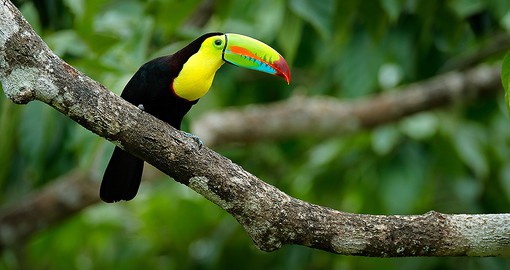
Panama's tropical environment supports an abundance of plants. Forests dominate, interrupted in places by grasslands, scrub, and crops. Although nearly 40 percent of Panama is still wooded, deforestation is a continuing threat to the rain-drenched woodlands. Tree cover has been reduced by more than 50 percent since the 1940s. Subsistence farming, widely practiced from the north-eastern jungles to the south-western grasslands, consists largely of corn, bean, and tuber plots. Mangrove swamps occur along parts of both coasts, with banana plantations occupying deltas near Costa Rica. In many places, a multi-canopied rain forest abuts the swamp on one side of the country and extends to the lower reaches of slopes in the other.
The Panamanian currency is officially the balboa, fixed at parity with the United States dollar since independence in 1903. In practice, however, the country is dollarized; Panama has its own coinage but uses U.S. dollars for all its paper currency. According to the Economic Commission for Latin American and the Caribbean, Panama's inflation as measured by weight CPI was 2.0% in 2006. Panama has traditionally experienced low inflation, as it shares currencies with the U.S.
The balboa replaced the Colombian peso in 1904 following the country's independence. The balboa has been tied to the United States dollar (which is legal tender in Panama) at an exchange rate of 1:1 since its introduction and has always circulated alongside dollars.
Panamanian banknotes, denominated in balboas, were printed in 1941 by President Arnulfo Arias. They were recalled several days later, giving them the name "The Seven Day Dollar." The notes were burned after the seven days but occasionally balboa notes can be found with collectors. These were the only banknotes issued by Panama and U.S. notes have circulated both before and since.
Tourism in the Republic of Panama kept its growth during the past 5 years. The number of tourists arriving between January and September 2008 was 1,110,000, 13.1% or 128,452 visitors. This was a significant increase to the 982,640 travelers who had arrived in the same period of 2007, a year that beat all records regarding the entry of tourists into the country.
The arrival of tourists from Europe to Panama grew by 23.1% during the first nine months of 2008. According to the Tourism Authority of Panama (ATP), between January and September, 71,154 tourists from the Old Continent entered the country that is 13,373 more than figures for same period last year. Most of the Europeans who have visited Panama were Spaniards (14,820), followed by Italians (13,216), French (10,174) and British (8,833). From Germany, the most populous country in the European Union, 6997 tourists arrived. Europe has become one of the key markets to promote Panama as a tourist destination.
In 2007 1.445.5 million entered into the Panamanian economy as a result of tourism. This accounted for 9.5% of gross domestic product in the country, surpassing other productive sectors.
Panama's Law No. 8 is still the most modern and comprehensive law for the promotion of tourism investment in Latin America and the Caribbean. In so-called Special Tourism Zones, Law 8 offers incentives such as 100% exemption from income tax, real estate tax, import duties for construction materials and equipment, and other taxes. Panama has declared different parts of the country as Special Tourism Zones which are benefited with multiple tax exemptions and tax holidays.
DETAILS - CANADA |
DETAILS - US |
|---|---|
| All travelers will need a passport valid for at least 90 days following your departure date. However, we strongly recommend traveling with 6 months validity on your passport at all times. Citizens of Canada can refer to www.passport.gc.ca for forms and instructions for new passport applications and Canadian passport renewals. | All travelers will need a passport valid for at least 90 days following your departure date. However, we strongly recommend traveling with 6 months validity on your passport at all times. |
6 itineraries are available for Panama
Email: info@goway.com • Accessibility at Goway • Privacy Policy
Booking Conditions Travel Insurance • Careers • Contact Us • Brochures •