
Australians are highly sociable people, coming together for celebrations centred around art, sport, food and drink, or to explore nature together via hikes, runs and swims. In many parts of the country, a strong sense of community predominates, cemented by frequent casual get-togethers like barbecues or visits to the pub with friends. If you’re invited to someone’s home for a get-together, it’s thoughtful to bring a small gift, such as wine or chocolates, or to contribute some drinks, snacks or desserts to the gathering. And don’t forget to enthusiastically join in the toast before taking your first sip when sharing a round of drinks!
Australia Travel Information
Not sure which theme is right for you?
Culture & Traditions
Composed of unique regions and landscapes, Australia is a vast and vibrant country boasting a unique blend of natural beauty, rich heritage and thrilling adventures-in-the-making. To exclude it from your bucket list would be to miss out. Let our Destination Specialists craft the perfect cultural journey just for you.
Indigenous Heritage: The Heart of Australia
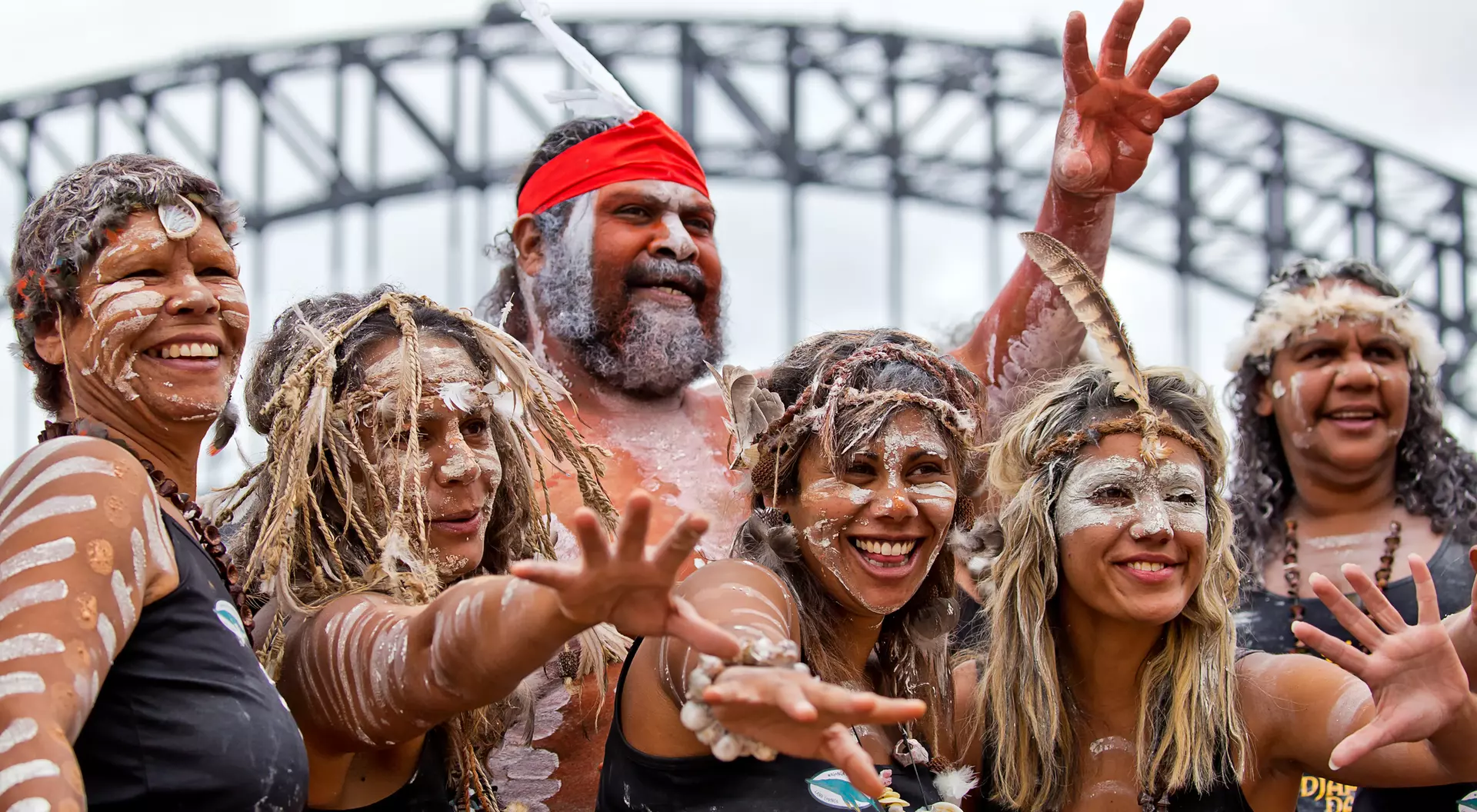
Prior to the European settlement of Australia, Australian Aborigines were among the oldest and most sustainable cultures on Earth. It is believed that they arrived by boat from Southeast Asia during the last Ice Age, some 65,000 years ago. Comprising 300 clans, 250 languages and 700 dialects, up to one million Aborigines lived in Australia before explorers colonized their lands.
“A lot of people don’t know that Australia has the world’s oldest living culture: Aboriginal and Torres Strait Islander peoples have lived on the continent for over 65,000 years.”—Alice Teramoto, Destination Specialist
As a result of colonization, Australia’s first peoples experienced a precipitous decline in their numbers and a suppression of their way of life, but their culture has not only survived but thrived in recent years. Today, the viewpoints of the Aboriginal and Torres Strait Islander peoples are commonly integrated into political and social life, while Aboriginal culture is widely recognized as an integral part of the modern Australian identity.
No visit to Australia—especially to such sacred sites as Uluru—would be complete without experiencing some aspect of Indigenous culture.
Modern, Multicultural Australia
In a 1967 referendum, Australians voted affirmatively to include Aboriginal peoples in their Constitution. The postwar years also saw a wave of migration to Australia from Europe, the Middle East and Asia, changing the cultural and linguistic makeup of the country’s cities and towns.
Today, Australia is one of the most vibrant democracies in the world, its political landscape a dynamic mix of both progressive and traditional forces. It is also one of the most globally minded of nations, having hosted several Olympics (the upcoming 2032 Summer Games will also be held in Brisbane) as well as some of the largest LGBTQ+ Pride parades in the world.
Social Etiquette & Local Customs
Australians are typically laid-back, friendly and relaxed, appreciating fairness, equality and mutual respect, regardless of social standing.
They also tend to be less physically affectionate with people they don’t know well, so handshakes and hugs aren’t always expected.
On the whole, Australians love coming together for informal get-togethers (such as barbies or drinks with friends at the pub) or to explore nature together.
Sporting events also set the stage for gathering and good-natured rivalry. For a real glimpse of Australia, take in a local rugby or Australian Football League (AFL) match at the famous MCG in Melbourne. Major sports gatherings such as the Australian Open, the Melbourne Cup and the Formula 1 Grand Prix should also be experienced.
Celebrations, Festivals & National Traditions
Traditionally a Christian country, Australia is today a diverse, multicultural nation home to more than 120 different faiths. That means that countless celebrations and traditions—both secular and religious—are celebrated throughout Australia.
Christmas in the country is warm and sunny instead of cold and snowy, so be prepared to enjoy freshly grilled prawns, lamb, steaks, and veggies if you visit in December instead of turkey and stuffing.
“One event that every traveler to Australia should experience,” says Destination Specialist Alice Teramoto, “is ANZAC Day. It is a poignant day, and whether you mark it by watching the ANZAC footy games, or taking part in a game of Two Up, always remember the reason behind it - remembering the Australian and New Zealand landing at Gallipoli in 1915”
The Arts, From Opera to Street Art
The arts play a crucial role in Australian culture, which boasts thriving music, theatre and visual arts scenes.
The iconic Sydney Opera House, which attracts operatic and other talents from around the world, is a must-see on any Australia vacation or cruise, as are the many vibrant murals that line central Melbourne’s labyrinthine alleyways.
Many Australian actors, musicians and artists have achieved international recognition, attesting to the strength of Australia’s creative industries. Notable talents such as Nicole Kidman, Cate Blanchett and Hugh Jackman continue to make movies and appear in plays in Australia.
Best of all, the country’s cultural riches can be enjoyed throughout Australia, from the cosmopolitan venues of multicultural Sydney and Melbourne to the Western Australian Museum in Perth to the edgy Museum of New Art (MONA) in Tasmania.
“Tasmania is under the radar for many travelers, but it’s great for hikes, natural landscapes and now modern art!”—Alice Teramoto, Destination Specialist
Talking With (and Like) Australians
Despite not holding official status, English is the universal language in Australia, meaning that English-speaking visitors will have no trouble communicating during their Australia vacations.
Having said that, the country is known for its rich and varied slang. For example, knowing the difference between “yeah, nah” (no) and “nah, yeah” (yes) will make navigating casual conversations easier.
Referring to new acquaintances on your Australia trip as “mates” is also a friendly way to build trust and rapport.
“One thing to note when asking for directions in Australia is that Australians tend to not use “north,” “south,” “east” or “west.” Rather, they’ll tell you to simply go “right” or “left” to get to a destination.”—Alice Teramoto, Destination Specialist
Planning Your Tailor-Made Cultural Adventure
Whether you’re looking to experience Uluru through an Indigenous lens, tour the National Gallery of Australia with your own personal docent or take a backstage look at the Sydney Opera House, Goway has you covered. Book your tailor-made Australia culture trip with one of our Destination Specialists today.
Travel Stories
Get inspired about Your Trip to Australia
Enjoy Lunch with a View on a Sydney Harbour Cruise
Sydney Harbour is one of those places that never loses its shine, no matter how many times you visit. Even after living in Sydney for six years, ever...
Nature & Wildlife
+1
My most frequent travel companions are my family. Every one of us considers ourselves to be an "outdoors person," but, like snobby sommeliers, our tas...
Nature & Wildlife
+1
People travel to far-flung destinations for all kinds of reasons: the food, the culture, the landscapes, the thrill of adventure. Increasingly, I’m dr...
Frequently Asked Questions
What are some key Australian social customs I should know about?
What should I know about Aboriginal and Torres Strait Islander cultures?
Aboriginal and Torres Strait Islander peoples have lived on the continent for more than 65,000 years, making theirs one of the oldest existing cultures in the world. Their philosophies and traditions, including art, storytelling and a connection to the land, continue to influence the broader Australian identity, both culturally and politically. Their distinctive dot paintings and dreamtime stories are renowned worldwide for their unique and evocative qualities.
Are there any unique aspects of city life in Australia?
Since understanding Australia’s Indigenous heritage is key to understanding the country in full, the culture of the Aboriginal and Torres Strait Islander peoples is a highlight of many of Goway’s vacation packages. At Uluru, for example, visitors gain a greater appreciation for the sacred natural site when they experience it through the lens of an Indigenous guide. The Daintree Rainforest, meanwhile, is as lush as Uluru is arid, but Aboriginal experts in both destinations can also provide a firsthand sensory experience of what it’s like to live there through everything from eye-opening nature walks to bush tucker tastings. For more on experiencing Aboriginal Australia in depth, consult one of our Destination Specialists today.
Are there any local phrases or slang I should know to fit in?
In addition to saying “g’day” with frequency, Australians love to utter “yeah” or “nah” before continuing a train of thought, which can get a little confusing if you’re trying to work out whether someone’s saying yes or no. In short, “yeah, nah” means no and “nah, yeah” means yes. When engaged in conversation (“having a yarn”) with Aussies, do feel free to address new acquaintances as “mates,” which is a friendly way of building trust and camaraderie. Do not, however, refer to anyone as a “bogan,” which is slang for an uncultured or unsophisticated person.
Are there any local food customs or table manners I should know?
Australian dining and drinking etiquette is generally relaxed and informal, but some customs are important to observe. Punctuality is valued, and it's polite to wait until everyone is seated and served before beginning to eat. Conversation is also encouraged, but controversial topics should be avoided until introduced by the host or another guest. In a restaurant or bar, it's common for bills to be split or for each person to pay their share, but it's also acceptable for the host to pay.
How do Australians celebrate public holidays and festivals?
Australians celebrate public holidays and special occasions with a mix of traditional activities and modern festivities, often centred around community gatherings, outdoor events and cultural performances. Many holidays, like Australia Day and Christmas, involve barbecues, fireworks and parades, while other celebrations such as Easter include church services, reflection and family time. Most banks, government offices and businesses are closed on major holidays
Australia Travel Information
Not sure which theme is right for you?
Unlock more by subscribing to our newsletter.
With our newsletter, you’ll get access to regular communications that inspire you and help you explore the world your way.Exclusive Savings
Insider Benefits
Trending Stories

ExcellentBased on 5,136 ReviewsThanks very much Alice Teramoto for organizing such a fantastic trip for us!!!!
Everything went very smoothly, including our 15 flights and we loved all the experiences, activities and accommodations that you arranged for us.
Everything was top notch!!!Shelley MurphyWe had an amazing trip to Southeast Asia. We would like to thank Goway for organizing a memorable vacation. The tour guides were very personable, kind, respectful and knowledgeable about their countries. It was nice to be able to ask them questions and hear about their daily lives. They went above and beyond to make our trip as enjoyable as possible. We were so glad our tours were private as the guides were very flexible in accommodating us as I often could not fully participate after spending time in a hospital with food poisoning.
We enjoyed our time in Singapore. The driver who drove us from and to the airport gave us a compressive overview of daily life in Singapore. It was fascinating to hear how home ownership, retirement and driving was so different there.
The accommodations were excellent, the staff were all very kind and helpful. We have to particularly commend the staff at the Siesta Classic Ma May in Hanoi. Ann at reception was so kind to my husband when I was in the hospital asking him regularly how I was doing and arranging late checkout without being asked. And Suzie our Hanoi tour guide for rearranging a tour time for my husband then dropping him off at the hospital. She also managed to take me to see the Ho Chi Minh property on our way to the airport as I had missed so much of Hanoi. I would also like to thank Aurel Vion, the Goway representative from Paris, who personally called me while I was in the hospital to enquire how I was doing, cancel our Halong cruise and arrange an extra night in the hotel for my husband. It was much appreciated.
Hoang was super flexible with our tours in Hue and Hoi An as I was still very weak having just gotten out of hospital. We really enjoyed our visit to the private pottery museum and meet the owner and our ride on the Perfume River in a private boat and our voyage through the mountain pass to Danang. Andy, the tour guide who picked us up from the Boutique Hoi A Resort helped us avoid the long lineups in the Danang airport, again very appreciated. Tuan our tour guide in Saigon was also very accommodating. We really enjoyed our days with him relaxing on our private sampan to Cai Be and our trip to Can Tho to visit the floating markets. He also took us to the War Remnants Museum on the way back to Saigon as we had missed our tour of the Cu Chi tunnels because our flight in Danang was delayed 4 hours.
And poor Phil in Bangkok, he tried his best with the culinary tour. Unfortunately after the food poisoning we were being very cautious in what we ate. We did appreciate his tour of Chinatown and the great meal of Pad Thai. He also provided us with excellent directions so we could take the subway, skytrain and ferry by ourselves.
We will never forget how we were able to experience and appreciate cultures much different than ours.
We have only good things to say about Goway and certainly always recommend the company to all we know. We have already had an acquaintance of ours book a trip with the company.
And lastly we must thank Katherine Samsonkinai for arranging another excellent vacation. We will certainly continue to recommend her and will be calling her again to organize our next big trip.
Linda GrahamWe thoroughly enjoyed our trip to Egypt. We were a small group trip with only three people. The guides and transfers from Emeco were excellent.Always on time and very knowledgeable. Our transfer went smoothly due to these guides. They were very efficient and made sure we didn’t have to wait in lines too long. The Sun Goddess was a beautiful riverboat and all of our meals were excellent. One suggestion is to include tips . We were always trying to find the right amounts for tips. Also the times for most excursions were very early in the morning….5:30 or 6:00 and that was not on our itinerary. I understand the early times to avoid the crowds. All in all we were very pleased with GoWay and would use them again in the future. Thinking of South Africa Safari.
Also would like to thank our agent Elise for answering all of my questions and concerns. We felt very safe in Egypt. Sue ScarboroughAs a travel agent, it was very easy to work with Goway. They were very responsive, especially Osvaldo Gonzalez, even when the client wanted to make in-destination changes a day or two prior. My clients absolutely enjoyed everything about their trip to Costa Rica - they specifically mentioned that all the drivers and guides they had were excellent, friendly, and knowledgeable. I would not hesitate to use Goway again for a custom trip to Costa Rica. Shawna Woods RoyWe, three couples, all enjoyed our time in Peru, despite the small amount of time we had, and the fact one person had injury while on the cruise prior to arriving in Lima. We did want to experience Machu Picchu without spending as many days as others usually do, since we had been traveling prior to that already. Kajal at Goway was able to tailor a well packed three-day private tour for our small group of six. Every detail, from the moment we got off the cruise ship, to Cusco, to Machu Picchu, and back to Lima airport hotel, was well taken care of. Kajal was very efficient in helping with the requested itinerary, and in staying on desired budget, as well answered all questions in timely fashion. We were able to accomplish what we were not sure if possible, all thanks to Kajal at Goway.
Our experience in Peru was very positive. We felt the tours organized by Goway had enabled us to have great and impressive exposure to Peruvian culture and important historical sights - all 31 hours in 3 days!!! Condor Travel in Peru took care of us every step of the way. Every person we came across was very courteous, willing, and helpful. Help was always there and questions answered quickly via Whatsapp. All in all a great and positive experience we would highly recommend.KMI want to personally thank my Travel Agent Alice Teramoto who organized two spectacular trips for me! One to Australia and most recently Vietnam and Cambodia. She nailed it! I can’t express my gratitude enough! Both trips were flawless and hassle free! Every experience exceeded my expectations!
I spent my 60th Birthday in Vietnam on the Lunar New Year which was a complete thrill!
I highly recommend Alice and will definitely book with her again soon! Thanks so much Alice ♥️👏🏻👏🏻👏🏻AvrilMary G. was an absolute pleasure to work with. I partner with Goway often for Europe and typically have my go to rep, so stepping outside of that for a New Zealand itinerary had me a little unsure at first.
That hesitation quickly disappeared. Mary stepped in with confidence, handled all of my moving pieces with ease, and truly understood the level of detail I needed to take care of my clients.
She delivered a beautifully curated itinerary that exceeded expectations, and most importantly, my clients had an incredible experience in New Zealand.
I’m so grateful to have her as a resource and look forward to working together again.Nichole PierceJoanna was amazing!!! She was able to set up a ten day trip for me in Sydney in a matter of a couple of weeks. All accommodation and tours were amazing and the 24 hour help center was great and where able to call up the tour company and have them come and still pick be up when I had a mixup with the reservation. Would definitely recommend Goway to any friends and family and will definitely be using them again.Erica WolffI cannot sing Erin’s praises enough! She planned an action-packed two-week New Zealand itinerary that hit every single stop on our bucket list. Every experience was truly first-class and luxurious. While I found myself being price-conscious initially, once I saw the incredible quality of the experiences she curated, I knew it was going to be the trip of a lifetime. A huge thank you to Erin and Go Way Travel for making my 50th birthday so epic. We’ll definitely be reaching out for our next big adventure!MichelleExpertise, experience, great information and tailored to just what my client needed!Stephanie
Verified
Verified
Verified
Verified
Verified
Verified
Verified
Verified
Verified
Verified