




Signature Thai dishes vary by region, but national classics include pad Thai (stir-fried rice noodles with tamarind, fish sauce, garlic, bean sprouts, tofu, and other additions), tom yum goong (hot-and-sour shrimp soup with lemongrass and makrut lime), and green curry (a fragrant coconut-based curry made with fresh herbs and chillies). Other essentials include pad kra pao (stir-fried meat with holy basil) and som tam (spicy green papaya salad). Each dish reflects Thailand’s emphasis on fresh ingredients and a quintessential blend of heat, sweetness, acidity, and salty flavours.
Thailand Travel Information
Not sure which theme is right for you?
Food & Drink
There’s a reason Thai food ranks among the world’s most beloved cuisines. Steaming plates of pad Thai, fragrant bowls of curry, and wok-fired stir-fries showcase the country’s mastery of balance, with spicy, sweet, sour, and salty flavours coexisting in harmony. Even if you’ve eaten at standout Thai restaurants around the world, nothing quite compares to experiencing the cuisine at its source.
From the moment you land in Bangkok, the country announces itself through scent and sound. Street-food stalls line night markets, while fine-dining restaurants reinterpret classic dishes with contemporary finesse. Across both ends of the spectrum, the building blocks are the same: fiery chilis, creamy coconut milk, tangy fish sauce, and aromatic herbs like Thai basil, lemongrass, galangal, and makrut lime leaves.
Select Michelin-starred restaurants focus on Royal Thai Cuisine, a refined style developed by the ancient Ayutthaya court. Often considered the pinnacle of Thai cooking, this style is governed by strict rules and presentation standards. Royal Thai dishes prioritize the freshest ingredients, meticulous preparation, and balanced flavours. Dishes are never overly spicy, all bones are removed to create smooth textures, and every element is visually appealing.
Perhaps the most remarkable aspect of Thailand’s food and drink scene is its consistency. Simple, homegrown ingredients are layered and seasoned so instinctively that you’ll wonder how it looks so effortless. Whether you’re settling in for a multi-course tasting or snacking your way through Bangkok’s old town, it’s genuinely difficult to have a bad meal, especially with a knowledgeable guide who knows where to go and what to order.
To learn more about the highlights of a food-focused journey to Thailand, speak to one of our Destination Specialists today.
A Culinary Overview of Thailand
From the mountains of the north to the southern islands, Thailand’s diverse geography influences what’s on the menu.
Most food tours begin in Bangkok, the capital of the country and the heart of central Thailand. For many travellers, the first order of business is trying authentic pad Thai. Institutions like Thipsamai and Baan Phadthai specialize in the iconic stir-fried noodle dish made with tamarind, fish sauce, tofu, bean sprouts, peanuts, garlic, and more. Other essentials include tom yum goong (hot and sour shrimp soup), pad kra pao (a stir-fry dish with holy basil), and pad see ew (broad noodles with Chinese broccoli). And for lovers of spice, a trip to Thailand wouldn’t be complete without sampling the country’s colourful trio of curries: yellow (mild), red (medium), and green (hot).
In northern Thailand, particularly around Chiang Mai, cooler temperatures and influences from Myanmar, Laos, and indigenous communities shape earthy, often milder dishes. Khao soi (a coconut curry topped with crispy noodles) is a regional standout, as is sticky rice served with chilli dips. Street food thrives here as it does in Bangkok, with moo ping (grilled pork skewers), khao neow mamuang (mango sticky rice), and khanom buang (crispy Thai pancakes) among the popular staples.
Travellers who venture to Isaan in the northeast are rewarded with bold and punchy flavours influenced by Laos. Som tam (spicy green papaya salad) originated here, alongside dishes like sai krok isan (garlicy fermented pork sausages) and larb (lime-seasoned minced meat). Protein-rich insect snacks are also common in these parts, giving adventurous diners one more experience to check off their list.
Along Thailand’s southern coasts and islands, such as Phuket, Koh Samui, and Koh Lanta, fresh seafood reigns supreme. Spicy and sour dishes featuring tamarind or pineapple complement coconut-based curries, including Massaman curry, a dish introduced by Muslim traders centuries ago. Spicy curries often cool you down, as does a scoop or two of Thailand’s iconic coconut ice cream.
Unique Thailand Dining Experiences
Thailand’s street-food culture dates back centuries. As urban centres expanded during the Ayutthaya period (1351-1767), merchants and labourers sought quick, affordable meals, giving rise to a tradition of vendors perfecting just one or two dishes at a time.
Chinese immigrants arriving in the 18th and 19th centuries left a lasting imprint, introducing techniques such as stir-frying, steaming, and deep-frying, seen today in classics like khao man gai (chicken and rice), khao kha moo (braised pork leg), and pa thong ko (crispy Thai donuts). This legacy lives on most vividly along Yaowarat Road in Bangkok’s Chinatown, one of the city’s most electric food scenes.
Beyond the street stalls, floating markets encapsulate Thailand’s long-standing relationship with its waterways, where vendors sell boat-to-boat noodles, grilled seafood, and coconut sweets. Equally integral are shophouses, family-run eateries with a nostalgic feel, where lunchtime crowds gather for traditional dishes cooked fresh.
One of the most important things to know about Thailand when it comes to dining is that food arrives as it’s ready rather than in formal courses, encouraging a relaxed, communal style of eating that reflects how Thais have enjoyed their meals for generations.
Thailand’s Beverage Scene
Thailand’s hot climate has led to an abundance of refreshing beverages. On most menus, you’ll find fresh fruit juices and herbal infusions like nam krajiab (a tangy drink made with hibiscus-like roselle blossoms). Other favourites include sweet and creamy Thai milk tea, cha manao (lime black tea), strong Thai iced coffee, blue-hued butterfly pea tea, and fresh coconut water.
Cold beers like Singha and Chang are the go-to alcoholic drinks and pair well with spicy food. You’ll also find a wide selection of craft beers, as well as cocktails—many of which include Mekhong (a.k.a. “Thai whiskey”), the national spirit distilled from molasses and rice and infused with native herbs.
Beyond the cities, tea plantations in Chiang Rai and the surrounding northern regions produce fragrant oolong, black, and green teas. Visitors can tour the estates, learn about cultivation and processing, and sample freshly brewed teas amid misty hills.
Dining Etiquette in Thailand
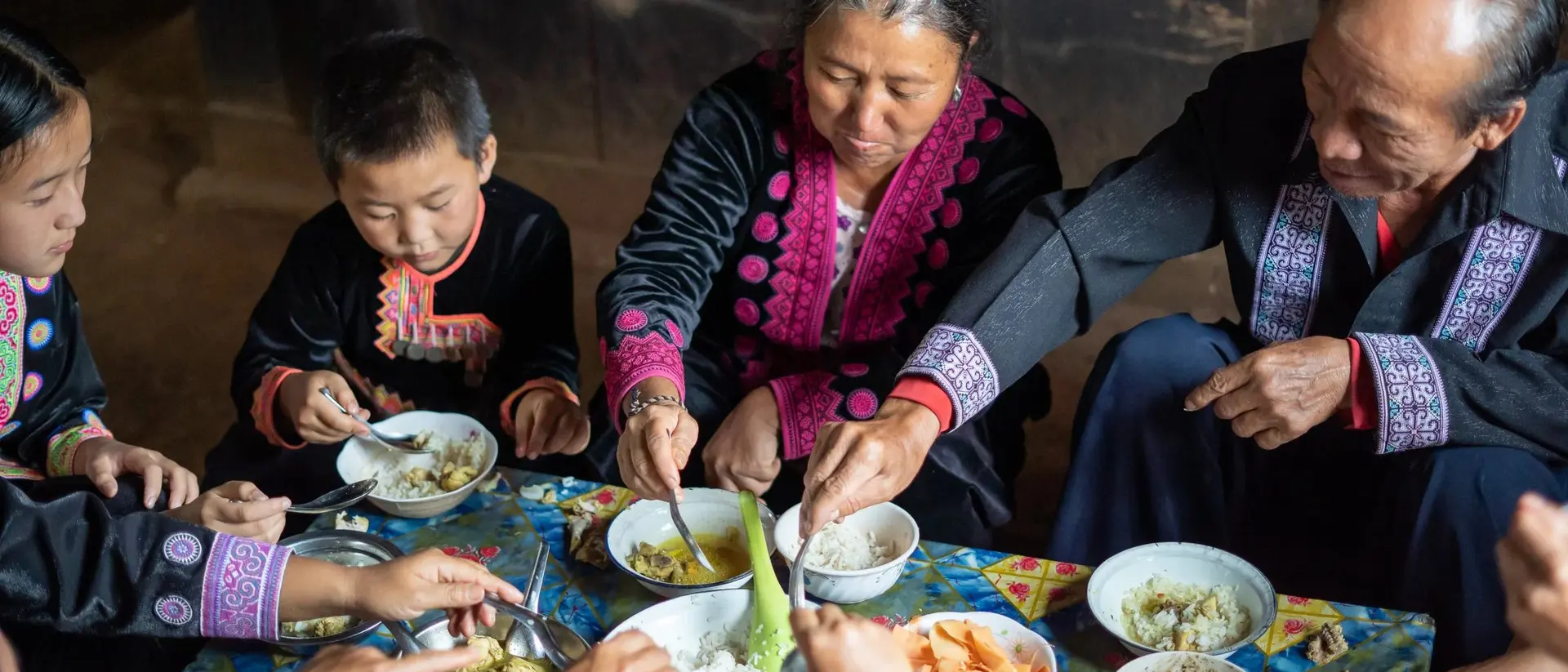
Whether at a roadside stall or a restaurant, meals in Thailand are social affairs. Dishes are often shared, allowing diners to sample a range of flavours and textures in a single sitting, from fiery curries and grilled meats to crisp salads.
Traditional dishes are often eaten with a spoon (held in your dominant hand) and a fork (held in your other hand). The fork is used only to guide food onto the spoon, not for eating, and chopsticks are reserved for noodle soups. Sticky rice and finger foods, such as spring rolls, are traditionally eaten with the right hand.
While wasting food is discouraged, it’s common to leave whole chillies on the plate, as they’re often meant to season the dish rather than be eaten outright.
When dining with locals, follow their lead. Respect is an important aspect of Thailand’s culture and traditions, so the host or eldest person usually orders, and it’s polite to wait for them to take the first bite before starting. Unlike in some other Asian countries, slurping your food is considered rude in Thailand.
Servers tend to give diners space. To request the bill, make eye contact, smile, and gesture with your palm down, curling your fingers toward yourself. Tipping isn’t required, though it’s appreciated. At higher-end restaurants, a service charge may already be included.
Accommodating Dietary Needs in Thailand
Thai cuisine is highly adaptable, making it amenable to travellers with dietary needs. Spice levels can usually be adjusted, though even “mild” may still feel hot to some. To avoid chilli altogether, say “mai sai prik” (pronounced “my sai prik”), which means “no chilli, please.” Dishes like pad thai and fried rice are typically mild by default.
Thailand is also exceptionally friendly for vegetarian, vegan, and halal travellers. Tofu is widely used, but fish sauce, eggs, and oyster sauce appear in many dishes, so inform your server or guide of any strict requirements. The same applies to peanut, soy, or shellfish allergies, since these are all common ingredients in Thai cooking. It’s recommended to travel with laminated allergy cards written in Thai or a local guide who can notify the restaurant of your dietary needs.
Plan Your Thailand Culinary Adventure
Culinary travel in Thailand often extends beyond the plate. Market visits, cooking classes, and walking food tours provide deeper insight into the cuisine. One afternoon, you might learn the art of flavour balancing with a local chef, then spend the evening tasting your way through bustling night markets.
Beyond the cities, travellers can explore local farms, or try picking and roasting tea leaves near Chiang Mai. Private trips to Thailand allow every detail to reflect your palate, whether you’re a pad Thai fanatic, adventurous foodie, or hoping to return home with a few recipes alongside the memories.
Book your Thailand food and drink journey with Goway today.
Featured Thailand Trip Ideas
Thailand Travel PackagesClassic Thailand: Bangkok, Chiang Mai & Phuket
Phuket, Chiang Mai, Bangkok, and The Grand PalaceDiscover the beauty of Thailand on this ideal introductory tour, from bustling Bangkok to tranquil Chiang Mai and stunning Phuket. Experience rich culture, ancient temples, and serene beaches on your vacation.
10 days
From US$2,738/p.p.
Request a Quote
Classic Thailand: Bangkok, Chiang Mai & Phuket
Phuket, Chiang Mai, Bangkok, and The Grand PalaceDiscover the beauty of Thailand on this ideal introductory tour, from bustling Bangkok to tranquil Chiang Mai and stunning Phuket. Experience rich culture, ancient temples, and serene beaches on your vacation.
10 days
From US$2,738/p.p.
Request a Quote
Travel Stories
Get inspired about Your Trip to Thailand
K-Beauty at the Source: Why Your Wellness Routine Leads to South Korea
South Korea's beauty industry has almost certainly reached your home already. According to Korea's Ministry of Food and Drug Safety, the country expor...
Hitting the Streets on a Pedicab Tour of Seoul
South Korea has earned a unique spot among Asian destinations for its food, history, traditions, and, more recently, its pop culture. Over the last se...
Exploring Rugged & Beautiful Mongolia
“Hold the dogs,” shouts the local guide as we approach a nomad’s home in the Gobi Desert somewhere in the middle of Central Mongolia. It’s a Mongolian...
Frequently Asked Questions
What are the signature dishes of authentic Thai cuisine?
How does street-food culture enhance the culinary experience in Thailand?
Street food is the backbone of Thailand’s food culture and one of the most immersive ways to experience local life. Vendors often specialize in just one or two dishes, serving them at peak freshness throughout the day or night. Eating street food allows travellers to sample a wide range of iconic specialties—from grilled pork skewers to Thai pancakes—in a single outing, often for just a few dollars (about 30 to 100 baht) per dish. The informality, speed, and social energy of street dining make it both accessible and exciting.
What are popular Thai desserts and beverages to try?
Thai desserts tend to be coconut-forward and often feature rice or tropical fruit. Mango sticky rice (khao neow mamuang) is the most iconic, pairing ripe mango with coconut-sweetened sticky rice. Other favourites include tub tim grob (water chestnuts in coconut milk), khanom chan (a layered cake made with tapioca flour), and roti drizzled with condensed milk.
Beverages are designed to cool and refresh in Thailand’s tropical heat. Standouts include Thai milk tea, cha manao (lime-infused black tea), fresh coconut water, sugarcane juice, and butterfly pea tea. For something stronger, cold local beers like Singha and Chang are the go-to, while cocktails often feature Mekhong, Thailand’s national spirit made with molasses, rice, and local herbs.
How do regional ingredients influence Thai cooking styles?
Thailand’s regional cuisines are shaped by geography, climate, and neighbouring cultures. In the north, the abundance of mountain herbs has led to milder, earthy dishes like khao soi (a coconut curry with cilantro, lemongrass, ginger, turmeric, and makrut lime leaves, topped with crispy noodles).
Northeastern Isaan cuisine is known for its bold, sour, and spicy flavours, with fermented fish sauce, lime, and toasted rice powder appearing in dishes like som tam (spicy papaya salad) and larb (lime-seasoned minced meat).
Central Thailand produces many of the dishes most familiar to international diners, such as stir-fries, often showcasing the region’s access to fresh vegetables and herbs, such as lemongrass, galangal, makrut lime leaves, and Thai basil.
In the south, coastal access means abundant seafood, best enjoyed alongside spicy curries with turmeric, coconut milk, and chillies.
Where can travellers find the best fine-dining experiences in Thailand?
Thailand’s fine dining scene is concentrated in Bangkok, which boasts multiple Michelin-starred restaurants and a growing number of internationally acclaimed chefs. Many top restaurants focus on refined interpretations of traditional Thai cuisine, including Royal Thai cooking and creative tasting menus highlighting regional ingredients. Beyond Bangkok, destinations such as Chiang Mai and Phuket are also home to exceptional fine dining, often set in serene settings. Reservations are typically recommended, and guided culinary itineraries can help travellers secure sought-after tables while providing cultural context that deepens the experience.
Thailand Travel Information
Not sure which theme is right for you?
Unlock more by subscribing to our newsletter.
With our newsletter, you’ll get access to regular communications that inspire you and help you explore the world your way.Exclusive Savings
Insider Benefits
Trending Stories

ExcellentBased on 5,310 ReviewsOur goal for this trip was a stress free honeymoon where we did not have to think about anything! GoAway made that successful. Everything was planned and ready for us. We just had to show up. Brooke recommended fantastic accommodations that were in great locations, clean and comfortable. The tours were took with Thompson's Africa were incredible as well. Brooke was helpful throughout the entire booking process process & we wouldn't have had such an incredible experience without her. We really loved our South African holiday and hope to travel there or other locations again with GoAway.TaylorOctober 9, 2026, was our 50th wedding anniversary. To celebrate, I wanted to take my bride to Europe for 50 days. Also, other than the flight over, I wanted to make the trip by train. I contacted Farnaz at Goway. The trip we planned ultimately extended to 60 days. It was absolutely flawless. We had great hotels, great tours. Even though this trip was complex and had a lot of moving parts, there were no problems. Farnaz and the folks at Goway done a great job. I highly recommend them and will definitely use them on any future tripsDaniel GraffWe had a fabulous Croatia vacation with a cruise from Dubrovnik to Split, followed by land tours on Split and Opatija. Lodging was always comfortable and conveniently located. Tours and activities were perfectly suited to our interests. We have used GoWay for 2 vacations and are currently working on another. KarenWe would like to thank our travel specialist, Bijal for all the planning and coordinating that was done to make our Tanzania trip as spectacular as it was from start to finish!
Everything went so smoothly from our transfers, to our accommodations, to all of our tours! The people we came into contact with were exemplary!
There were so many highlights on our trip from the animal sightings, to the balloon flight and champagne breakfast, to all the incredible scenery.
Our accommodations were stunning! The level of service was remarkable and the locations were beyond our expectations. To think we would be having dinner and seeing the zebras and the elephants in the distance was amazing!
Our tour guide/driver was very knowledgeable, friendly, passionate and had a keen eye for spotting animals in the distance. He made sure that we saw all the animals that we had hoped to see. it was truly a pleasure to spend the week with him.
Thank you again to Bijal for all the work in making this once in a lifetime trip so exceptional!! We look forward to having Bijal help us plan our future trips.The Chadwicks and WilliamsI wanted to do a once in a lifetime vacation but had no idea where to start, other than knowing where I wanted to go. I reached out to goway.com and Jessica (shoutout!), who is an expert on our specific destination, sent me an itinerary quickly! She had me going into the jungle one day, so I requested to swap that nonsense for a fishing charter, and before I knew it, my trip was ready.
We just returned and it truly was a once in a lifetime experience! The resort service was top notch and (according to locals) we had all of the BEST activities the island has to offer.
If you are up in the air at all as to whether or not going through goway is worth the money, I'm here to tell you: If it's peace of mind and a perfect vacation you're looking for, do it now.therealitgirlWe recently worked with Jacqueline to plan our trip to Greece and had a wonderful experience. We made several revisions to our itinerary and Jacqueline was patient, understanding and prompt in responding to our needs. In addition to the specific tours she booked, she provided extra options and local suggestions for each place we visited in Greece. Her attention to detail and responsiveness made our trip incredibly memorable. Mark MendellWe have used Goway several times to plan simple & more complicated trips. The last 2 trips we worked with Brooke Theron who is extremely customer focused. She listens well & is alway flexible to look at alternatives. We will continue using this representative & Goway.
Our only criticism is that they do not break down the various costs of a trip which makes tipping very awkward. It can also create a sense of " mistrust" when all the costs are not transparent. Cheryl HayesOur trip to Switzerland was an amazing experience. Our travel agent at GoWay, Bo was so helpful in helping my husband Louie plan just what we wanted to do on this trip. Taking the trains thru the county was easy by the many hours Louie and Bo worked on this. Also our helicopter ride in Zermatt on my birthday was just unbelievable. Flying around the Matterhorn and the Alps is one flight we will never forget. Thanks Bo for setting this up. The trip was one incredible adventure that we will never forget. Thanks again Bo, Lynn Gerber. Lynn GerberWe booked a Goway tour to Botswana and Zimbabwe and it was excellent. We worked with Brooke, the Goway represntative, to set up the tour and she was an outstanding agent who answered any questions we had very quickly and completely. Her hotel recommendation for the additional night we stayed was pefect.
Goway hires a local tour group, Jenman Safaris, to lead the safari in the 2 countries. The tour itself was amazing...the lodges that we stayed at were very nice and the food was great (except for one lodge's food). The Goway itinerary was slightly different than the actual Jenman Safari itinerary but most of the sites that we went to were the same as listed on the Goway itinerary. I would use Goway again because their choice of a local tour group was very good...nice lodges/camps and good food and knowledgeable tour guides.Ma FaOur GoWay tour representative, Michael Keon, was on top of all of our concerns and questions in a professional manner and we look forward to working with him in the future. Michael was very easy to work with and treated us like family.Thomas
Verified
Verified
Verified
Verified
Verified
Verified
Verified
Verified
Verified
Verified